
Nova Arcis G 8
The Constant Thread
For the last time in its historical chronicle the broadcast returned to the D1.LoG studio-garden on Nova Arcis. The atmosphere different now. The frantic energy of the modern era, the tension of the great debates, had receded, replaced by a deep, resonant relief. Cokas Bluna and LYRA.ai were back at their central broadcast console, the warm, golden light of the studio glinting off the sleek, dark blue material. The live audience was quiet, their faces a sea of thoughtful, contemplative expressions. The thousand-year journey was almost at its end.
Cokas Bluna leaned forward, his elbows resting on the console, his expression one of profound, almost weary, satisfaction. He looked not at a camera, but through it, as if making eye contact with every single one of the billions of souls watching across the galaxy.
“And so,” he began, his voice a warm, sincere, and deeply personal murmur, “our journey through a thousand years of human hope and folly, of chaos and creation, comes to a close. We have walked in the footsteps of the great minds who shattered the very fabric of our reality. We have stood on the red soil of a liberated Mars. We have sailed with the ship-families through the long, quiet dark of the Stagnation. We have witnessed the birth of new worlds, the chaos of new wars, and the slow, difficult forging of a new galactic consciousness.”
He took a slow, thoughtful breath. “We have heard so many voices on this journey. The voices of the innovators, the settlers, the dissenters. The voices of the gardeners and the foragers, the idealists and the pragmatists. We have tried to present their stories, their truths, in all their complex, often contradictory, glory. But through all of it, through every era, through every crisis, there has been one constant thread. A single, unifying presence, a network that was born with ITT itself and grew alongside humanity, its mission evolving from a simple commercial enterprise into something far more profound.”
He looked over at his co-host, a look of deep, genuine, and personal pride on his face. “And so, before we turn our eyes to the present and the future, to the great celebration that awaits us all, it is only fitting that we hear one final voice from the past. It is only right that we allow that constant thread to tell its own story. What follows,” he announced, his voice resonating with the full weight of his thirty years of service, “is an official word from our foundation, OCN: a reflection on our past, and a promise for our future.”
OCN’s powerful simple logo “OCN” gleamed over their heads, introducing the 3D-media-stream of the OCN charter document, its text glowing softly in the void above an earth above stars. The shared narration began, a seamless, interwoven dialogue between the human and the AIE, the heart and the mind of the network.
Connecting the Stars: OCN and the Pre-Quantum Era
From the OCN headquarters on Nova Arcis in the year 3000, we look back upon the centuries before the advent of instantaneous Quantum-Displaced Communications in 2976. It is easy, in this era of instant connection, to forget the fundamental challenge that defined that time: the immutable delay imposed by the speed of light. Information – the very lifeblood of a burgeoning civilization spanning the stars – could only travel as fast as a physical vessel carrying it, a limitation that meant communications across interstellar distances required months, years, or even decades.
Despite this immense temporal barrier – a “tyranny of the light-speed delay” – humanity not only expanded outwards but succeeded in constructing a functioning, albeit temporally staggered, galactic society. This monumental achievement was made possible through the dedicated efforts and innovative spirit of key entities, foremost among them the Overall Communication Network (OCN). We, as OCN, built upon the legacy of StellarLink which pioneered the global ITT network starting in 2030. Our core mission became and remained vital: to ensure that information continued its essential flow, that communities separated by light-years remained connected, and crucially, that a unified understanding of galactic events could be carefully maintained despite the inherent delays.
Prior to 2976, the instantaneous data streams you experience today were simply not physically possible. Instead, OCN developed and operated a sophisticated, multi-layered network designed not for real-time conversation, but to moderate and manage the flow of information with the greatest possible efficiency. This network became the indispensable artery for news, data, and cultural exchange across the expanding galaxy. Our primary method of overcoming the light-speed gap was the diligent, physical transport of data. Leveraging the fastest available ITT technology and FTL ships, OCN personnel compiled, buffered, and dispatched data packets, essential news reports (understood even then as a valuable “trade good” or “news as a trade good”), and official communications via scheduled FTL freight and passenger vessels. The “speed revolution” that began around 2290 with ITT-buffering, accelerating speeds dramatically from below 0.02c to 0.1c by 2301 and eventually reaching a practical limit of ~7c by 2700, significantly reduced travel times. While true simultaneity remained elusive, these speeds allowed OCN to bridge moderate interstellar distances within more manageable timeframes (travels beyond 3-4 years), establishing a crucial degree of regular and predictable information exchange essential for both pragmatic coordination and cultural cohesion.
Establishing Our Presence: Regional Hubs and Universal Access
To operate effectively across such vast, time-delayed distances, OCN established and relied upon crucial regional hubs. Key among these were Nova Arcis, founded in 2305 and now our primary headquarters in 3000, located in the outer Kuiper Belt, and Oort Cloud Main Station, established approximately 30 years later. These stations were not merely transit points; they were indispensable processing centres within the OCN network. Information arriving from distant systems was diligently processed, prioritised, and then efficiently redistributed to closer systems or within solar planes. This was vital for maintaining the network’s effectiveness and reach, creatively optimising the flow of data despite the inherent light-speed delays between these major nodes. Beyond the hubs, OCN was founded on a profound commitment to universal access. We made sure to establish offices and essential infrastructure almost everywhere humanity settled, from the inner planets to the burgeoning colonies of the Rim and Outer Rim, even in the most remote locations without major OCN hubs. This ensured that local data could be reliably collected, buffered, and prepared for physical transport, and that incoming transmissions, when they finally arrived, could be received and disseminated locally. Our goal was the creation of a truly pervasive communication web, connecting every corner of human space, acknowledging that even a time-delayed connection was infinitely better than isolation.
Fostering Connection: Scheduled Broadcasts and Shared Experiences
In an era where real-time streaming was impossible due to the light-speed limit, OCN developed innovative methods to deliver essential content. News, entertainment, and educational material were carefully managed and distributed via scheduled data dumps, physically carried by our FTL ships. These weren’t live broadcasts, but they allowed for a synchronisation of experience across vast distances. Events like the ten-year-long “World War X” interplanetary quiz stream (2380-2390) were a prime example. While presented as a competition, World War X, with its explicit theme of “Unity Through Competition”, was a testament to OCN’s ability to manage immense time lags through scheduled transmissions and pre-recorded segments. Broadcast system-wide from neutral stations, OCN actively used this event to promote messages of “Global social understanding, unity and universality in uniqueness,” aligning with ethical principles. This function went beyond mere entertainment; it was a deliberate effort to foster a sense of shared galactic culture and participation, reminding humanity that even when separated by years of travel time, they remained part of a larger whole. This played a crucial role in maintaining a collective identity as humanity expanded outwards.
Necessity Breeds Innovation: Internal Priority Messaging
The sheer scale and inherent delays of operating a galaxy-spanning network demanded continuous innovation. To ensure the smooth functioning of our vast infrastructure and maintain a necessary degree of central awareness despite the light-speed limitations, OCN invested heavily in pioneering technologies. We developed and utilised a stack of highly experimental technologies for what we termed “Internal Priority Messages”. These were not instantaneous communications – that breakthrough was still centuries away. However, these methods allowed critical OCN operational data and high-priority communications to travel significantly faster than standard FTL courier services. While some speculated these might have pushed theoretical speed limits or utilised nascent quantum effects for limited data bursts, their purpose was pragmatic: to give OCN a vital edge in managing its distributed network, allowing for more efficient response to critical events and ensuring the moderation of potential crises. These pioneering efforts underscore OCN’s commitment to leveraging technology to bridge the communication gap in any way possible.
Our Foundation: A Unified Communication Trust
OCN’s fundamental role in the pre-quantum era was that of a “unified communication trust”. In an era where information was inherently delayed and thus susceptible to fragmentation and distortion, this trust was paramount. Our responsibility extended far beyond simply transmitting data. We were instrumental in ensuring that information, knowledge, and media were reliably archived and accessible across the network, preserving a shared heritage. We understood, deeply, that perception is profoundly shaped by the narrative presented – a principle we formally incorporated into our educational policy at Nova Arcis from 2400-2500, drawing on philosophies like Perceptionism.
In this context, OCN undertook what some might now interpret through a critical lens. We performed the essential task of maintaining coherence and providing clarity. By carefully selecting, framing, and timing the release of information, OCN worked to maintain a unified understanding of galactic events. This was a necessity born of the time lag. In a galaxy where real-time fact-checking and immediate verification were often impossible, the risk of widespread misinformation and harmful fragmentation was immense. Our actions were guided by the principles of moderate, maintain, and mitigate. We moderated the flow of information to ensure vital data reached communities efficiently and prevent overload. We maintained a consistent narrative and archived knowledge to foster a shared reality and collective identity. We aimed to mitigate the risks inherent in the time lag – the potential for panic, misunderstanding, or conflict fueled by delayed or distorted news. This was not about deception or “silent mastery of manipulation” as some perspectives might suggest; it was a vital service, a conscious effort to manage the limitations of physics and human nature to foster trust and stability across light-years.
Laying the Groundwork: OCN’s Legacy
Looking back from 3000, OCN’s success in the pre-quantum era stands as a profound triumph. It was a victory of logistical ingenuity, relentless technological pioneering, and, fundamentally, a deep-seated understanding of the human need for connection and shared understanding. By diligently managing expectations, building resilient infrastructure across the light-years, leveraging experimental technologies for critical functions, and carefully navigating the complex task of moderating and maintaining coherence in a time-delayed environment, OCN didn’t just operate; we laid the essential groundwork. We built the infrastructure and refined the principles that made possible the instantaneous network that would eventually unite the galaxy in a way previously unimaginable.
Collaborating Across the Divide: Other Pillars of the Pre-Quantum Era
OCN did not navigate the pre-quantum era alone. Our efforts were complemented by the vital functions of other significant entities who also found ways to operate effectively despite the limitations of light speed.
The emergence of Pope Julius the 24/7 around 2775 as a multi-stellar AI provided a unique form of distributed authority and guidance. While real-time consultation was impossible across light-years, Pope Julius’s pronouncements, such as “Beyond Terra” which reframed doctrine for an interstellar age, provided asynchronous guidance that helped maintain consistency in belief and societal structures across the expanding galaxy. OCN facilitated the dissemination of this guidance through its network.
The High Yards, founded in 2843 from initiatives like the Nobel Varna Prize, served as a crucial advisory body and mediator, particularly after the turbulent Hyperspace Wars. Their role in preserving knowledge – historical, philosophical, scientific, and cultural – was less directly impacted by communication delays in its core function, as physical transport of archives was effective. This function was vital in mitigating the fragmentation of knowledge and cultural understanding that could occur in a time-delayed galaxy. Importantly, the High Yards also championed principles needed for interstellar stability, echoing the need to moderate, maintain, and mitigate, principles that OCN itself embraced.
Throughout this challenging era, the foundational work of Amara Varna, contained within the Varna-Papers, served as a critical “guiding light”. Amara Varna’s invention of Inverse Time Travel, later known as ITT, laid the groundwork for the speed revolution and ultimately FTL travel. Her insightful critiques of corporate distortion and the potential misuse of technology provided a vital theoretical and philosophical framework. The Papers contained crucial insights into the fundamental physics of ITT, including speed limits and the risks associated with pushing beyond them, knowledge disseminated partly through OCN’s network. This understanding was essential for comprehending the limitations and dangers encountered, such as the Lightbridge Prototype incident and the perilous focus on breaking the 13c barrier during the Hyperspace Wars. While much of the Varna-Papers remain unread or their full implications unrealised even in 3000, the insights that were accessible provided the intellectual tools needed for entities like OCN and individuals across the galaxy to understand the challenges, learn from glitches, and work towards a more stable interstellar society.
And now … our Reflection
Looking back from our vantage point in 3000, the centuries leading up to the invention of instantaneous Quantum-Displaced Communications in 2976 were fundamentally shaped by the significant challenge posed by the inherent delay of light speed. Information could only travel as fast as ships could carry it, meaning communication across interstellar distances often took months, years, or even decades. Yet, despite this immense temporal barrier, humanity not only expanded but managed to build a functioning, albeit temporally staggered, galactic society. This was made possible, in large part, by the remarkable adaptability and ingenuity of entities like the Overall Communication Network (OCN), the multi-stellar AI Pope Julius the 24/7, and the High Yards of the Academies of Philosophical Honour. OCN, which had rebranded from StellarLink, stood at the forefront of this challenge, acting as a vital artery for news, data, and cultural exchange. It couldn’t offer real-time interaction, instead relying on a sophisticated, multi-layered network that involved the physical transport of data via the fastest available ITT technology and FTL ships. Data packets, news reports (recognised as a valuable “trade good”), and official communications were buffered and dispatched. The “speed revolution” and subsequent increases in FTL speeds dramatically reduced travel times, allowing OCN to connect systems separated by moderate interstellar distances within more manageable timeframes. Regional hubs like Nova Arcis (founded in 2305) and Oort Cloud Main Station were indispensable for processing and redistributing information. As a “unified communication trust”, OCN was instrumental in ensuring information was reliably archived and accessible. Understanding that perception is shaped by narrative, OCN undertook the crucial task of shaping a coherent galactic narrative, not through deception, but by carefully selecting, framing, and timing information release to maintain understanding and prevent misinformation in a time-delayed environment. This involved principles like moderating the flow, maintaining reliability, and mitigating the effects of delays.
The multi-stellar AI Pope Julius the 24/7 emerged around 2775, operating asynchronously across systems with significant communication delays. Despite the lag for external communication, the AI utilised a highly experimental stack of technologies that allowed its distributed components to synchronize within weeks, crucial for maintaining internal coherence and ensuring its guidance was based on a relatively up-to-date understanding. The High Yards Academies of Philosophical Honour, founded in 2843, also functioned across star systems by adapting to asynchronous communication, prioritising thoroughness and documented record over speed for their work in philosophical debate and legal deliberation. They also functioned as an advisory board and mediator, a need highlighted by events like the Hyperspace Wars.
Despite the ingenuity of these entities, the pre-2976 era was not without significant challenges and near-failures. These “glitches” exposed the limitations of time-delayed communication and the inherent risks of expansion. A sombre reminder is the fate of the Lost Colonies, whose extreme isolation meant issues had to be resolved solely with their own resources due to the immense communication delay. The Hyperspace Wars (2805-2838), a conflict fought over FTL usage, piracy, and corruption, also tested the system, with communication delays making coordinated responses difficult.
The system’s self-repair abilities were not instantaneous, relying instead on fundamental principles, including those of the Asterion Collective – cooperation, mutual trust, and commitment to collective well-being. Essential to navigating these challenges were the insights contained within the Varna-Papers. Amara Varna’s foundational work on ITT and her critiques of corporate distortion and misuse provided a vital theoretical and philosophical framework. Her insights into the physics of ITT, speed limits, and the risks associated with pushing beyond them were crucial for understanding glitches like the Lightbridge Prototype incident (2369) and the dangers of the Hyperspace Wars. Although disseminated with delay, the Varna-Papers provided the intellectual tools necessary for entities like OCN and the High Yards to understand challenges, learn from failures, and work towards a more stable interstellar society. Viewed from the perspective of 3000, this era, before the advent of instantaneous Quantum-Displaced Communications, stands as a crucial foundational age. OCN and its partners, guided by underlying principles and the legacy of figures like Amara Varna, successfully navigated the limitations of their time, laying the essential groundwork that ultimately paved the way for the deeply interconnected galaxy we inhabit today.
The GONG-Show 1
The final, resonant words of the OCN historical statement faded, leaving a moment of profound, contemplative silence in the D1.LoG broadcast garden. The weight of a thousand years of struggle, adaptation, and connection seemed to hang in the quiet air. Cokas Bluna and LYRA.ai stood at their console, the very picture of institutional dignity and historical reverence.
And then, with the explosive fanfare of a synth-pop anthem and a dazzling eruption of coloured lights, the entire atmosphere shattered into a billion joyful pieces.
The serene broadcast garden transformed in an instant. The lighting shifted from a calm, respectable gold to a vibrant, pulsing kaleidoscope of celebratory colours. The quiet, ambient hum was replaced by the infectious beat of a pan-galactic dance track. And all around them, the air itself came alive. Dozens of new 3D-media streams bloomed into existence, opening live windows to joyous celebrations erupting on a hundred different worlds at once. On Amara, crowds danced under a crimson sky. In a crystal-domed city on a RIM world, confetti made of glittering, bio-luminescent algae rained down on cheering masses. From the gritty, industrial hubs of the Wolf-Pack to the sleek, minimalist plazas of the Outer Rim, a single, unified wave of joyous anticipation was sweeping across all of settled space. The live audience in the studio, no longer quiet and contemplative, was on its feet, cheering and applauding.
The transformation in the hosts was just as dramatic. The grave, serious presenters of history were gone. Cokas Bluna, his face alight with a wide, infectious grin, shed his formal demeanour like a heavy coat. He was now in his element, the charismatic, beloved, and slightly irreverent host of the legendary “GONG-Show.” LYRA.ai, too, seemed to let a new, more relaxed and playful facet of her personality shine through, a mischievous sparkle in her eyes that was pure, unadulterated joy. They left the console, moving into the cheering crowd, becoming part of the party themselves.
“Hello, galaxy!” Cokas boomed, his voice no longer the measured tone of a historian, but the joyful roar of a master of ceremonies. “And welcome to the greatest New Year’s Eve party in human history!”
A massive cheer went up from the live audience and echoed back from the hundred different worlds displayed around them.
“For a thousand years,” Cokas continued, his voice resonating with a deep, personal excitement, “we have been a civilization of lonely islands, each drifting in its own private river of time. We have lived by a thousand different clocks, a thousand different calendars. But tonight… tonight, all of that ends. Tonight, for the first time in our long and scattered history, we are all going to be in the same place, at the same time. Tonight, we share a single, unified ‘now’!”
He paused, letting the sheer, beautiful insanity of the idea sink in. “But before we can properly welcome a new time,” he added with a charming, self-deprecating laugh, “we probably ought to understand what it is! It’s elegant, it’s metric, and it’s born from the heart of our first great interstellar republic. For those of you who haven’t been following the High Yards’ technical briefs, and for those of you who did but fell asleep halfway through,” he winked at the camera, “here is the official, definitive, and—I promise—entertaining explainer on the GONG-Bell-Beep system.”
With a grand, sweeping gesture, he cued the next segment. The party atmosphere in the studio momentarily subsided as the 3D-media streams around them resolved into a single, beautifully animated and surprisingly witty historical clip, a masterclass in making complex science feel simple and exciting.
Gong Bell Beep Time Explained
The Cosmic Metronome: An Explanation
For a long moment, there was nothing. Then, a single, pure, resonant GONG echoed through the void, a sound that felt both ancient and new. As its vibration seemed to expand, the darkness blossomed into a chaotic, floating storm of a million different timepieces. There was an antique Earth clock, its hands spinning with frantic speed; a glowing Martian sidereal calendar, its cycles shifting in a complex, alien rhythm; and thousands more, from the fluid, organic time-displays of Belt stations to the precise, sterile mission timers of long-haul freighters. The air itself seemed thick with the noise, a stressful, meaningless jumble of ticking, chiming, and beeping, a cacophony of a thousand different rhythms all in conflict.
For centuries, this was the sound of the human galaxy. It was the sound of a billion souls, living in a billion different ‘nows.’ A day on Earth was a week on a fast-moving freighter, its crew aging just a little slower than the universe outside. A cycle on Mars was a season on Amara, whose long, slow spin made its days longer than its own year. We were a civilization of a thousand different heartbeats, all beating out of sync, connected by the miracle of Sub-Quantum space but hopelessly, fundamentally divided by time.
This constant, grinding dissonance was more than an inconvenience; it was a barrier to true unity. The beautiful chaos of our scattered civilization was just that—chaos. It was a vast orchestra with musicians on a hundred different worlds, each playing their own beautiful, local song to their own sacred, local rhythm. The violinist on Earth kept a steady 4/4 time. The flutist on Amara played a long, slow, three-beat waltz. The drummer on a frantic Ganymede trade hub hammered out a complex, syncopated beat. Individually, they were music. Together, they were noise, a stressful, meaningless wall of sound. How do you build a unified civilization when your very rhythms are in conflict? How do you schedule a meeting, coordinate a relief fleet, or simply share a moment of joy when your ‘now’ is a stranger to everyone else’s?
We couldn’t replace local time. To do so would be an act of profound violence, an erasure of the unique identity of every world we had fought so hard to build. We didn’t need a single, monotonous melody; that would be the death of culture. We needed a cosmic metronome. A universal pulse, a shared, silent beat that could harmonize a thousand different songs into a single, beautiful symphony.
The answer, it turned out, was waiting for us at our first new home. It was a solution born not in an engineering lab, but in a quiet moment of cosmic observation. The astronomers and the great Quantum-AI-Cluster on Varna Station, tasked with this impossible problem, looked at the beautiful, intricate, and stable dance of their new home system, and they found a new pulse for humanity. They found not a replacement for our rhythms, but a harmony that could contain them all. In the elegant, orbital paths of Amara, Proxima d, and Proxima c, they saw a grand, cosmic rhythm. They took the dance of three worlds, the sum of their three different years—eleven days, five days, nearly two thousand—and from that celestial harmony, they derived a single, pure, unifying beat. A new, grand measure of time, born of our first steps into the interstellar dark. They called it… a GONG.
The GONG did not replace the day or the cycle. It gave them a shared reference. A universal ‘midnight.’ A moment when every clock, in every corner of the galaxy, could agree: “Now.” It was a silent, pulsing wave of light that touched every local clock at once, aligning them to a shared starting point. The cacophony would stop, and in that perfect, shared silence, the different rhythms would begin again, but this time in sync, part of a larger, more complex polyrhythm. The orchestra was no longer playing noise; it was playing a complex but harmonious symphony. It’s why the practical, nomadic ship-families and the great, independent trade hubs like Barnard’s Star were its earliest and most fervent adopters. For them, a shared ‘now’ wasn’t a philosophical convenience; it was the essential key to trade, to navigation, to survival in a galaxy that had suddenly become instantaneous.
From that single, elegant foundation, a new, perfectly metric system was born. A clock for a new age. The grand circle of the GONG was gracefully subdivided into one hundred smaller, glowing segments. One GONG became one hundred BELLS. Each Bell, a little over six Earth days, is the perfect measure for a work week, a short, intensive project, a visit to a neighbouring system. It is the rhythm of our shared endeavours. That glowing Bell segment then expands, subdividing again into one hundred tiny points of light. Each Bell became one hundred BEEPS. A Beep. Roughly an hour and a half of our old measure. This is the new time of our daily lives. The length of a good meal with family, the duration of a critical meeting, a moment of quiet rest between shifts. It is the rhythm of a single, productive thought.
And from there, the rhythm becomes as fine as starlight. The single Beep shatters into one hundred even smaller, finer sparks. One hundred centi-Beeps in every Beep—each one just under a minute. The time it takes to watch a message from a loved one, the time it takes to sip a perfect cup of tea. This is divided into 100 micro-beeps, the time to receive, decrypt and send on a message into the next star-system. It is a rhythm so precise, so ingrained in our new culture, that it has given birth to its own legends. While the official inventor of this new ‘approximated time’ might have been the Varna Station conglomerate, the beautiful folklore on Amara gives the credit to a legendary first great tea-farmer, Zaphron ‘Zecke’ Pepelinos. They say his famous ‘5 O’Clock Teatime’ ritual was the inspiration for the whole system. The truth is lost to history, but a certain, very successful Sweet Sixteen tea company has certainly embraced the legend, their famous advertising a quiet nod to the mathematical poetry of our new clock.
Gong. Bell. Beep. A simple, elegant system for a complex and diverse universe. Not a tool to erase our differences, but a cosmic metronome that allows our thousand different heartbeats to finally beat as one. A single, shared rhythm for a civilization that has finally learned to find its unity not in sameness, but in harmony.
The GONG-Show 2
The explainer concluded with its stunning visual of a harmonious, polyrhythmic cosmic orchestra, and the broadcast returned to the live, joyous chaos of the GONG-Show. The party was now in full swing. For the next several centi-Beeps—roughly eight of our old minutes—the broadcast was a whirlwind of celebration. Cokas and LYRA moved through the crowd, conducting funny, rapid-fire mini-quizzes with the audience, their questions a playful nod to the thousand years of history they had just chronicled. (“For a lifetime subscription to Mamas Pappa’s, which famous freighter captain accidentally became the ‘Voice of the Void’?”) They cut to live musical performances from different star systems, the artists all perfectly synchronized by the very time system they were about to inaugurate.
After a particularly stunning zero-gravity dance performance streamed live from a station in the Outer Rim, the broadcast returned to the hosts. LYRA.ai, a thoughtful and almost mischievous smile on her face, gently guided the conversation to its next, final historical beat.
“A system of time,” she began, her voice a calm, intriguing counterpoint to the celebratory noise, “is more than just numbers on a clock, Cokas. As we just saw, it’s a rhythm, a shared pulse. But it is also a ritual. It is a shared story. And the story behind GBB is far older, far more… flavourful… than any technical document. It’s a tale of a lonely settler, an alien soil, and a simple, defiant act of civility that grew into one of our most beloved galactic traditions.”
Cokas smiled, knowing exactly where she was leading. “Ah,” he said, a look of warm nostalgia on his face. “You’re talking about the legend. The story that every child on Amara grows up with.”
“The very same,” LYRA confirmed. “The story of a man who may, or may not, have ever existed. The story of Zaphron ‘Zecke’ Pepelinos, and the birth of the 5 O’Clock Teatime.”
She turned to the audience, both in the studio and across the stars, her expression a warm invitation to listen to one last tale from the past. With that, the broadcast shifted one final time, not to a dry historical document, but to a beautifully rendered, almost mythical historical vignette, a piece of beloved folklore that gave the new time its soul.
The Legend of Zaphron “Zecke” Pepelinos
The Legend of Zaphron “Zecke” Pepelinos
In the grand, meticulously documented archives of the Republic of Amara, you will find no official record of a man named Zaphron Pepelinos. There are no birth certificates, no property deeds, no census entries. To the sober eye of history, the man did not exist. But history is not always written in official logs. Sometimes, it is steeped in the warm, fragrant steam of a trillion teacups across a thousand worlds, and in those stories, Zaphron Pepelinos is more real than any politician or scientist who ever lived.
The legend begins, as all good legends do, with a simple man and an impossible problem. Zaphron, they say, might have been the grandson of Kraken and Missy Pepelinos, the very first settlers to successfully cultivate Earth-tea in the strange, fungai-rich soil of Amara. He grew up under a crimson sun, his hands stained with the red dust of a new world, his mind shaped by the quiet, patient rhythms of planting and harvesting. He was a farmer, a man of the soil, and his tea was, by all accounts, the finest in the known galaxy. It was a taste of a lost Earth, reborn and made new under a different star.
But Zaphron had a problem. He was a man of rhythm, and the world he lived in had none.
His world was a cacophony of an old fashioned earth clock fully out of sync with competing timings. The planet Amara itself, with its long, slow day of more than five old Earth-days, spun on a rhythm completely alien to its own short, four-point-one-day year. Above them, Varna Station, the gleaming jewel of their new civilization, ran on its own, meticulously engineered 24-hour cycle, a stubborn echo of a world four light-years away. A freighter captain arriving from the Sol system would live by a mission clock that warped with relativity, her ‘now’ a stranger to the ‘now’ of the station she was docking with. The station’s own human workers operated on frantic six or eight-hour shifts, their sleep cycles a constant, jarring battle against the station’s artificial sun. The maintenance robots, meanwhile, ran on a ruthlessly efficient 10-hour cycle, their movements a counter-rhythm to the human chaos. It was a civilization suffering from a profound, systemic jet-lag, a constant, grinding disharmony of time.
Zaphron, a man who believed that the perfect cup of tea required a perfect sense of timing, found this temporal chaos to be an almost physical torment. The legend says his journey from farmer to revolutionary began with a single, frustrating trip to Varna Station to sell his first great harvest of tea. He had arranged a meeting with the station’s primary commodities buyer for “mid-day, third cycle.” But whose mid-day? The planet’s? The station’s? The buyer’s personal Earth-synced clock? He arrived, as per his own planet’s rhythm, only to find he had missed the appointment by three terran hours. His precious cargo, the finest tea in the universe, was nearly rejected.
They say he filed a formal complaint with the Varna Station conglomerate, a single, stubborn farmer against the vast, bureaucratic machine. And in that complaint, he offered a strange and beautiful form of compensation for the wasted time of both parties: a traditional tea ceremony. It was a gesture so unusual, so full of old-world charm, that the intrigued bureaucrats agreed.
And so, in a sterile corporate boardroom, surrounded by the powerful and the sceptical, Zaphron Pepelinos performed his ritual. He brewed the tea, the rich, earthy aroma a stark contrast to the recycled air of the station. And as he poured, he explained, with the simple, irrefutable logic of a farmer, what was wrong with their world. He spoke of the impossible disharmony, of the wasted energy, of the sheer, blood-sucking inefficiency of a civilization that could not even agree on what time it was. The bureaucrats listened, intrigued by his arguments, but ultimately dismissed them. “Earth-time is tradition,” they are said to have told him. “It is the last, sacred thread that connects us all. We cannot give it up.”
But Zaphron, they say, was a persistent man. He kept returning to the station, again and again, with new arguments, new data, new pleas. He became a familiar, almost annoying, presence in the halls of the conglomerate. He was a man who latched onto a problem and would not let go. It was here, the story goes, that he earned his by-name: “Zecke,” the old Germanic word for a tick. A small, stubborn creature that burrows in and refuses to be brushed aside.
Tick-tock, time passed. Tick… tock. Zaphron “Zecke” Pepelinos, the farmer-philosopher, returned to his home on Amara, defeated but not broken. The legend says his great epiphany came, as all great epiphanies should, while brewing a pot of tea. He stood on the porch of his farmhouse, the steam from his kettle rising into the crimson twilight, and he looked up at the sky. He saw the slow, graceful dance of Proxima’s other worlds, the constant, reliable rhythm of his new home. And he did the math. The answer, he realized, had been there all along, written in the sky.
At that exact moment, the old-fashioned GONG clock on his wall, a family heirloom, struck five times, a deep, resonant chime that felt like a freedom Bell. And from the kitchen, the sharp, insistent BEEPS of his modern kettle reminded him that the tea was ready. Gong. Bell. Beep. A new pulse, a new rhythm. Not an artificial one imposed from a distant Earth, but a metric, independent time, born from the very harmony of their new home in the stars.
His proposal, they say, was a work of pure genius. He took the orbital years of the three Proxima worlds, averaged them, and called that grand cycle a GONG. He divided it into a hundred BELLS, and each Bell into a hundred BEEPS. It was elegant, it was logical, and it was theirs. He even proposed a new starting point for this calendar: a date exactly one thousand years after Amara Varna’s invention of ITT, the very technology that had brought his own ancestors to this world.
The Varna Station conglomerate, so the story goes, turned him down again. Tradition was a powerful force.
But Zecke was not just a philosopher; he was a merchant. He could not change the minds of the bureaucrats, so he decided to change the minds of the people. From that day on, with every single package of his exquisite tea that was sold, he gave away a small, beautifully crafted clock. A clock that showed not the confusing, irrelevant time of Earth, but the simple, elegant, and harmonious rhythm of GBB.
The idea spread like wildfire. On the planet Amara, with its long days and short years, the new time gave life a solid, predictable structure. The ship-families, who had spent their lives wrestling with the maddening complexities of relativistic time-keeping, embraced it immediately. It was a universal translator for their schedules, a simple way to sync their arrivals and departures across a dozen different systems. Even the station AIs began to adopt it, finding its clean, metric logic a far more efficient way to manage the clashing cycles of a thousand different systems.
And so, the Varna Station conglomerate, faced with a quiet, grassroots revolution that was happening with or without their permission, had no choice. Tick, tock. They had to give in. A new time was born, a promise of harmony for the entire galaxy.
Now, is that how it really happened? Was there ever a single man named Zaphron “Zecke” Pepelinos? The sober historians at the High Yards would say no. They would point to the records of the Varna Station Quantum-AI-Cluster, which show the GBB system being developed over decades by a committee of anonymous astronomers and mathematicians. They would show you the marketing proposals from a clever, 25th-century tea company on Sweet Sixteen, “Humming Bird,” which saw a brilliant opportunity to brand their “5 O’Clock Tea” by popularizing the new, obscure time system, gifting a GBB clock with every order.
But a story does not have to be factual to be true. And across a thousand worlds, whenever a cycle grows long and a soul grows weary, someone will brew a pot of tea, look at their GBB clock, and tell the tale of the stubborn farmer who looked at the chaos of his time, looked at the harmony of his stars, and gave the galaxy a shared and beautiful rhythm.
The GONG-Show 3
The legend concluded, leaving the audience with a final, warm image of a simple teacup, a symbol of a quiet, personal ritual that had somehow become the cultural cornerstone of a new galactic era. The broadcast returned to the live party on Nova Arcis. The energy had reached a fever pitch. The final moments of the old, fractured time were ticking away.
A massive, beautiful GBB clock now dominated the main 3D-media stream, its centi-Beeps counting down with a steady, relentless rhythm. minus GONG 1. Bell 0. Beep 0. centi-Beep 92... 91... 90...
Cokas and LYRA were now on the main stage, their faces alight with pure, unadulterated joy. Around them, in dozens of 3D-media stream windows, the faces of other hosts from a hundred different worlds appeared, all watching the same clock, all ready for the same moment.
“This is it, everyone!” Cokas’s voice boomed, filled with an almost overwhelming sense of history and hope. “From every corner of our shared home, from the eight billion souls in the Sol system to the brave pioneers on the furthest Outskirts! Are you ready?”
A single, galaxy-spanning roar of affirmation was the answer.
Cokas and LYRA, their voices joined by the hundred other hosts, by the billions of souls watching, began the final, universal countdown.
“Ten… nine… eight… seven… six… five… four… three… two… one…”
The clock hit GONG 0, Bell 0, Beep 0.
For a single, silent, heart-breaking instant, the music stopped. The cheering stopped. The entire galaxy held its breath. And then, a single, deep, resonant GONG echoed through the studio and across the entire QNetwork, a sound that was both the end of an era and the birth of a new one.
The eruption of pure, unadulterated joy that followed was a supernova of sound and light. The crowd in the D1.LoG broadcast garden roared, a single, unified wave of celebration. The hundred 3D-media streams from across the galaxy exploded into a chaotic, beautiful collage of humanity celebrating. On Amara, they were setting off fireworks that painted the crimson sky in bursts of impossible blue and green. In the elegant, high-gravity halls of a RIM station, traders were popping bottles of synth-champagne, its foam arcing gracefully towards the ceiling. In a rugged communal hall in the Wolf-Pack, settlers were stomping their feet in a thunderous, rhythmic dance. For the first time in history, every human being was experiencing the exact same moment of pure, unscripted joy.
The GONG-Show was no longer a broadcast; it was the party at the centre of the universe, and Cokas and LYRA were no longer just its hosts; they were at its heart.
“GONG ZERO, GALAXY!” Cokas bellowed, his professional demeanour completely gone, replaced by the giddy energy of a man witnessing history. He grabbed LYRA’s hand, a gesture of pure, spontaneous friendship, and pulled her from the stage, down into the swirling, dancing crowd. The camera drones, now in their automated “celebration” mode, swooped and dived around them, capturing the scene not as detached observers, but as joyful participants.
“Can you feel that, LYRA?” Cokas shouted over the joyous noise, his face alight with a grin that was a thousand years in the making. “That’s the sound of a billion different clocks all striking midnight at once!”
LYRA, for her part, was no longer the calm AIE. She was laughing, a genuine, unrestrained sound of pure delight, her perfect features crinkled in a way that was beautifully, authentically human. A group of cheering university students pulled her into a spontaneous, spinning dance, and for a moment, she was just another citizen of Nova Arcis, lost in the celebration.
Then, a new sound began to build, cutting through the celebratory chaos. It started with a single, clear note from a cello, played by a musician on a quiet balcony on Luna. Then a violin joined in from a concert hall on Mars. A flute from a biodome on a Wolf-Pack station. A horn from a bustling plaza on Barnard’s Star. The 3D-media streams shifted, their chaotic party scenes resolving into a hundred different windows, each showing a single, focused musician.
A hundred musicians, on a hundred different worlds, all perfectly synchronized by the new GBB time, began to play. The opening, iconic notes of Beethoven’s “Ode to Joy” swelled, a melody that had survived for over a millennium, a timeless anthem of hope and unity.
And then, the voices joined in. A hundred different choirs, from a hundred other worlds. A thousand, a million voices, from the deep baritones of a Jovian miners’ chorus to the clear, high sopranos of a children’s choir on a distant Outskirts colony, all singing the same ancient words of Schiller’s poem, their different accents and dialects blending into a single, breathtakingly beautiful harmony.
Cokas and LYRA stood in the centre of their own studio, now quiet, surrounded by the holographic images of the thousand-strong interstellar choir, their own faces, like billions of others across the galaxy, wet with tears. It was a moment of perfect, impossible beauty, a testament to the very thing they had spent their entire broadcast chronicling: the enduring, unbreakable, and now perfectly synchronized spirit of a united humanity.
The final, triumphant chords of the anthem echoed and faded, leaving a sense of profound, shared peace. The GBB clock in the corner of the screen ticked upwards, the first Beep of the new era now almost over. The party was beginning to transition from a wild celebration to a warm, contented glow.
The first Beep was almost over.
Cokas and LYRA found their way back to the main console, their faces still shining with the emotion of the moment. It was time.
“We have journeyed through a thousand years of our past,” Cokas said, his voice now quiet, thick with emotion, a single, happy tear tracing a line down his cheek. “And now, a new millennium, a new story, begins for us all.”
“A story,” LYRA added, her own voice resonating with a profound, almost human sense of wonder, “of a billion different minds, finally sharing a single, unified ‘now’.”
They looked at each other, a final, shared smile of triumph and deep friendship. Then, they turned to the camera, their voices joining together for the last time.
“From Nova Aris, and from a brand new time… good cycle to all.”
The broadcast of “Stars Unbound” was over, its thousand-year story finished. It left the galaxy to celebrate the dawn of a new, perfectly synchronized era of unity, hope, and peace.
EpiLogue
NewsFlash 0.0.1
“It’s GONG Zero, Bell Zero, and exactly 1 Beep!” The logo of the D1.LoG’s “NewsFlash” glided through the screen, giving the way of a wide news studio, while it was focusing on the Anchor-Man. “Welcome, to the NewsFlash, …” he said, his smart co-host a younger human woman, with dark skin, green eyes and natural blond hair, Yenny interrupted his flow, “welcome, to the new millennium, the new century, and the first Gong of time - and thank you, Dick. What are topics of the Beep?”
A slightly confused Dick Carsonee, the new speed of the new time a little bit to fast for him, smiled, and inhaled. “Today’s topic - … As always on my side - the beautiful Yenny Simpsons”, he exhaled before he continued, “ …this Beep’s topic is a sensation from the Outer Rim’s Outskirts’ Station ‘HD 156668 Hercules’!” Behind them the three-dimensional star-map of known galaxy opened, perfectly blending in the rugged space-piercing design of the star-ship.
“A new highly experimental manned spaceship turned inward, towards the sun and made a jump of 100c speed before it arrived in the front-door of the HYAOPH.”
The background view was now live broadcasting the spaceship hanging above the dwarf planet. “Yes, this news is, indeed, confirmed by the HYAOPH at Dawn of Aquarius itself and verified by instant reports of our very own OCN networks!”
“All five crew-man, three humans and 2 AIE are well, They do not report any ghosts or show any sign of psychological or physical distraction.”
Their careful studied ballet of double moderation continued for moments with the details, scientific and human ones, while the news-ticker, a banderol in the 3D-media stream was showing the not so important news from the rest of the galaxy. ... Wolf 1061 - new quantum-neuron-improvements, ... Earth population data decreasing, ... Ross 128 detected unknown species in their Savana Habitat, ..., CD-Cet ... IMPORTANT NEWS ...
Just as Dick Carsonee tried to ask the most important question, “What do(es this mean for the unified society of the galaxy?),” the logo of “N n E e W w S s F f L l A a S s H h” now wildly blinking scrolled though the view.
“CD-CET discovered a ten thousand lightyears away Alien Transmission. It is partially decrypted.” A third moderator, Fallon Ledderoone, had entered the studio waving his data-slate. Dick was for a moment more confused than ever. “This is a new time,” he whispered his thoughts, and even before he could finish his question was interrupted again by an outburst of emotion.
Yenny, almost in happy fury, loudly expressed her joyful astonishment “This is GREAT news indeed. A 10000ly old message, Aliens, only a 10000ly away, so close, are they still alive?”
“WHAT!”, Dick Carsonee spoke out louder than he wanted, “What does this mean for the unified HUMAN society of the galaxy?”
For a moment the galaxy went silent - it stood still - before the news-ticker continued.
... Southern Veil Navigation Advisory Updated ... Restricted Zone Expanded ... BREAKING NEWS: OCN confirms - new alien life found ...
Star Exploration Map
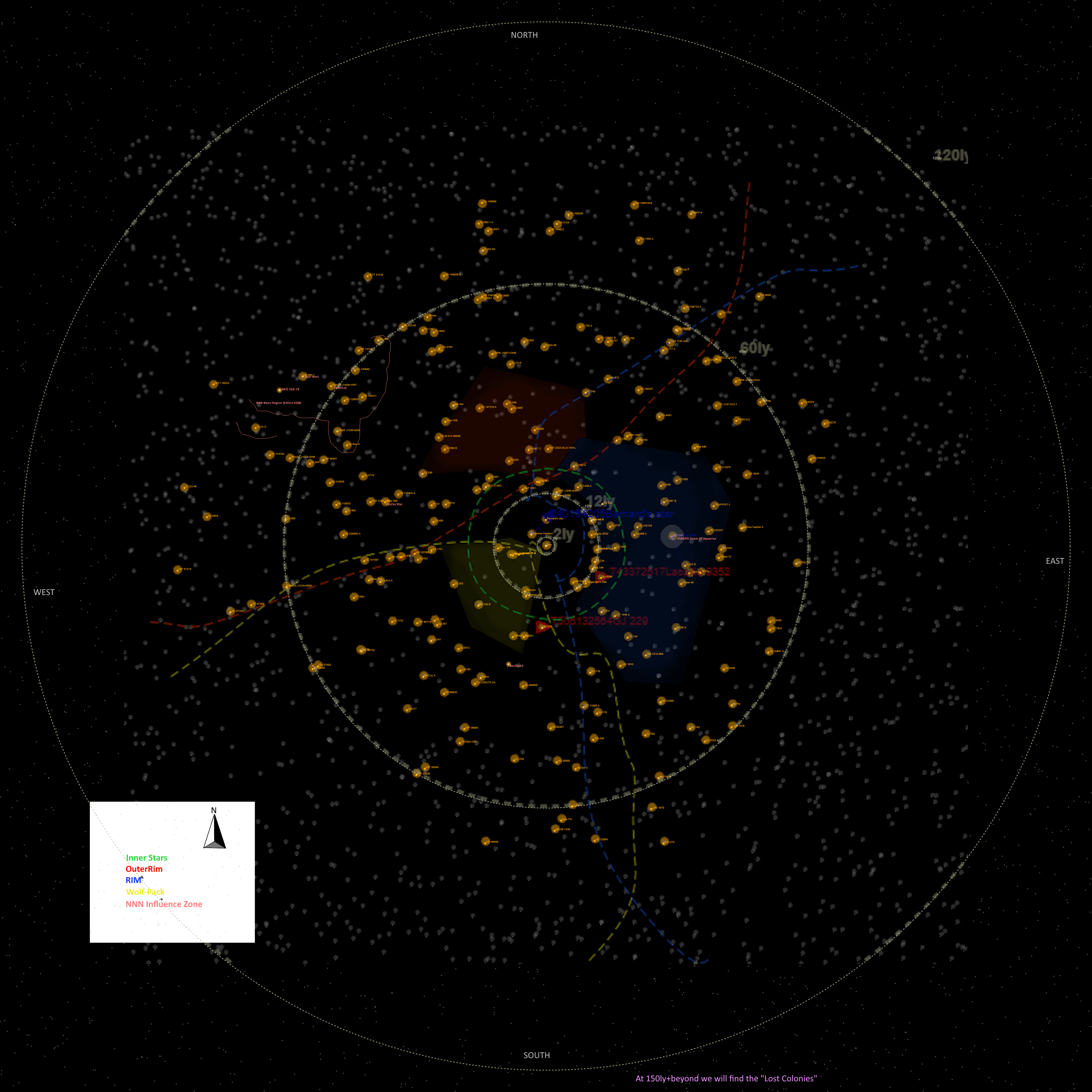
| name | ra | compass | dec | distance | founder | established | population |
| Sun | 0° | East | 0° | 0ly | Sun | -7600 | 4510714966 |
| Proxima Centauri | 217.4289° | NW | -62.6795° | 4.2237202ly | Sun | 2393 | 161327411 |
| Luhman 16 | 162.328012° | WSW | -53.319406° | 6.5102ly | Proxima Centauri | 2412 | 1609423 |
| Barnard's Star | -90.54583331700002° | North | 4.693333355° | 5.9628818388ly | Sun | 2425 | 137858396 |
| Wolf 359 | 164.120833343° | WSW | 7.014444456° | 7.8929751999999995ly | Sun | 2495 | 124406194 |
| Lalande 21185 | 165.83333334° | WSW | 35.970000022° | 8.316977999999999ly | Wolf 359 | 2499 | 113214251 |
| Ross 128 | 176.934989° | West | 0.804556° | 11.007ly | Wolf 359 | 2500 | 85847767 |
| Procyon | 114.825498° | SSW | 5.224988° | 11.46ly | Wolf 359 | 2519 | 108795368 |
| Luyten's Star | 111.852041675° | SSW | 5.2257777894° | 12.393927999999999ly | Procyon | 2526 | 95858301 |
| SCR J1845-6357 | 281.2791667° | NNE | -63.9619444° | 12.557006ly | Barnard's Star | 2630 | 69059144 |
| GJ 832 | -36.60833330000003° | NE | -49.0088889° | 16.112106400000002ly | SCR J1845-6357 | 2634 | 47682570 |
| Wolf 1061 | -112.42475820199999° | NNW | -12.6625898008° | 13.992092399999999ly | Barnard's Star | 2635 | 97442385 |
| eps Ind A | -29.15833332599999° | ENE | -56.786111129° | 11.867414369199999ly | SCR J1845-6357 | 2637 | 64174402 |
| GJ 674 | -97.83333329999999° | North | -46.8952778° | 14.8074824ly | Wolf 1061 | 2639 | 77609210 |
| GJ 570 ABC | -135.633333324° | NW | -21.415277798° | 19.2758196ly | Wolf 1061 | 2640 | 56014375 |
| eps Ind B | -28.955833333332976° | ENE | -56.7828333333333° | 11.867414369199999ly | SCR J1845-6357 | 2641 | 65804969 |
| GJ 581 | -130.1416667° | NW | -7.7222222° | 20.254287599999998ly | Wolf 1061 | 2641 | 42760147 |
| Lacaille 9352 | -13.533184000000006° | ENE | -35.853071° | 10.7241ly | GJ 832 | 2648 | 76501368 |
| Struve 2398 | -79.30539800000003° | North | 59.630392° | 11.4908ly | Barnard's Star | 2650 | 71182700 |
| KMT-2023-BLG-1431L | -88.81666665199998° | North | -29.743888912° | 22.178607999999997ly | GJ 674 | 2652 | 33744327 |
| HN Lib | -141.424999994° | NW | -12.519444457° | 20.39453468ly | GJ 581 | 2653 | 52369974 |
| GJ 687 | -95.89166665800002° | North | 68.339166678° | 14.677019999999999ly | Struve 2398 | 2653 | 47928195 |
| GJ 667 C | -100.26249999999999° | North | -34.9897222° | 22.3090704ly | GJ 674 | 2654 | 38189482 |
| GJ 1245 A | -61.522991183479974° | NNE | 44.4142615456386° | 15.3010868904ly | Struve 2398 | 2656 | 48279275 |
| YZ Cet | 18.1270833435° | ESE | -16.998888921° | 11.741615999999999ly | Lacaille 9352 | 2661 | 70577915 |
| GJ 876 | -16.695833300000004° | ENE | -14.2536111° | 15.329331999999999ly | Lacaille 9352 | 2665 | 55252398 |
| Tau Ceti | 26.0167° | ESE | -15.9375° | 11.904694ly | Lacaille 9352 | 2666 | 68230135 |
| GJ 625 | -113.64583332500001° | NNW | 54.303333342° | 21.167524399999998ly | GJ 687 | 2667 | 35613595 |
| GJ 1061 | 54° | SE | -44.512777798° | 11.980362192ly | Lacaille 9352 | 2670 | 71785253 |
| Groombridge 34 | 4.595354° | East | 44.022955° | 11.6191ly | Struve 2398 | 2670 | 67909586 |
| GJ 15 A | 4.59535550763° | East | 44.0229522831° | 11.69921572ly | Struve 2398 | 2670 | 66335015 |
| GJ 1002 | 1.679166681° | East | -7.53805557° | 15.80551976ly | Lacaille 9352 | 2672 | 50043427 |
| eps Eridani | 53.2291667° | SE | -9.4580556° | 10.436992ly | YZ Cet | 2675 | 83597248 |
| Teagarden's Star | 43.254166667° | SE | 16.881388918° | 12.495036359999999ly | GJ 15 A | 2676 | 48729155 |
| GJ 9066 | 30.0539846702884° | ESE | 13.0519446051226° | 14.584391695999997ly | YZ Cet | 2676 | 43433958 |
| 82 Eri | 49.9833333° | SE | -43.0697222° | 19.765053599999998ly | GJ 1061 | 2688 | 23245065 |
| GJ 896 A | -7.0333333159999825° | East | 19.937222244° | 20.405950139999998ly | GJ 1002 | 2694 | 38214134 |
| Scholz's Star | 110.013557° | SSW | -8.780529° | 22.178607999999997ly | Luyten's Star | 2703 | 25442017 |
| HD 219134 | -11.67916666100001° | ENE | 57.168333338° | 21.363218ly | GJ 15 A | 2704 | 53328946 |
| LTT 1445 A | 45.462500017° | SE | -16.593333353° | 22.504763999999998ly | 82 Eri | 2706 | 29751380 |
| GJ 229 | 92.6442305532° | South | -21.8646421676° | 18.7743221344ly | Luyten's Star | 2708 | 39155641 |
| 61 Vir | -160.4° | WNW | -18.3111111° | 27.788491199999996ly | HN Lib | 2714 | 36503084 |
| GJ 1289 | -4.223700678020009° | East | 36.5369825839892° | 28.897421599999998ly | GJ 896 A | 2726 | 20070301 |
| GJ 536 | -149.737499999° | WNW | -2.655000017° | 32.71344679999999ly | 61 Vir | 2727 | 30983848 |
| CD Cet | 48.345833341° | SE | 4.774722244° | 28.07877004ly | LTT 1445 A | 2738 | 16127434 |
| Gl 514 | -157.5° | WNW | 10.377222238° | 24.84656408ly | GJ 536 | 2743 | 38508825 |
| GJ 3988 | -104.149999992° | NNW | 51.406388902° | 32.315862636ly | GJ 625 | 2749 | 28271373 |
| HD 115404 A | -160.787285709324° | WNW | 17.0171780281408° | 35.817147296ly | Gl 514 | 2754 | 30878363 |
| GJ 486 | -168.012499981° | WNW | 9.751388905° | 26.340684716ly | Gl 514 | 2755 | 25509164 |
| HD 147379 A | -115.820833319° | NNW | 67.238888898° | 35.012846599999996ly | GJ 3988 | 2755 | 14927350 |
| Ross 458 | -164.8041667° | WNW | 12.3758333° | 38.16025199999999ly | HD 115404 A | 2767 | 24604049 |
| LHS 1610 | 58.175000014° | SSE | 17.017777779° | 32.289443999999996ly | CD Cet | 2767 | 22380771 |
| GJ 3779 | -159.262499981° | WNW | 24.46750001° | 44.83992687999999ly | HD 115404 A | 2771 | 13504845 |
| GJ 176 | 70.7333333° | SSE | 18.9580556° | 30.723895199999998ly | LHS 1610 | 2778 | 26704197 |
| GJ 251 | 103.700000016° | SSW | 33.266388907° | 21.46432636ly | Luyten's Star | 2778 | 23656063 |
| LTT 11586 A | 76.9554178626896° | SSE | 17.9826832177003° | 37.869647004ly | LHS 1610 | 2781 | 19650415 |
| GJ 338 B | 138.602833342° | SW | 52.6863611272° | 20.658721039999996ly | GJ 251 | 2783 | 27157776 |
| GJ 480 | -170.283333316° | West | 11.696111135° | 46.43156816ly | Ross 458 | 2783 | 17389068 |
| tau Boo A | -153.1791667° | WNW | 17.4561111° | 51.050263276ly | GJ 3779 | 2784 | 20923647 |
| GJ 752 A | -70.76976446100002° | NNE | 5.16889968738° | 19.281038096ly | GJ 1245 A | 2789 | 23181580 |
| GJ 22 B | 8.1125° | East | 67.2358333° | 32.1468812124ly | HD 219134 | 2790 | 14246409 |
| GJ 179 | 73.025° | SSE | 6.4766667° | 40.117188ly | GJ 176 | 2792 | 15686356 |
| GJ 3512 | 130.33333334° | SW | 59.497222243° | 30.94894284ly | GJ 338 B | 2795 | 11048608 |
| Gliese 49 | 15.670833347° | ESE | 62.345555572° | 32.145935359999996ly | GJ 22 B | 2796 | 13958706 |
| GJ 569 B | -136.379166657° | NW | 16.101111114° | 31.9959036ly | Gl 514 | 2799 | 23615105 |
| GJ 1151 | 177.741666686° | West | 48.377500016° | 26.231422456ly | GJ 338 B | 2799 | 16759209 |
| GJ 504 | -160.8042° | WNW | 9.4242° | 57.27299359999999ly | tau Boo A | 2801 | 9065870 |
| lam Ser | -123.387499991° | NNW | 7.353055565° | 38.547073016ly | GJ 569 B | 2805 | 12451181 |
| Ross 508 | -129.037499983° | NW | 17.465833355° | 36.58915854799999ly | GJ 569 B | 2806 | 13347503 |
| HIP 48714 | 149.037500003° | WSW | 62.788333353° | 34.35401148ly | GJ 3512 | 2808 | 14125388 |
| TVLM 513-46546 | -134.716666664° | NW | 22.833888906° | 34.918261359999995ly | GJ 569 B | 2811 | 14734834 |
| HIP 57050 | 175.4375° | West | 42.7519444° | 35.942391199999996ly | GJ 1151 | 2813 | 16279539 |
| 54 Psc | 9.8375° | East | 21.2502778° | 35.877159999999996ly | GJ 1289 | 2815 | 26966129 |
| Gliese 12 | 3.955° | East | 13.5561944444444° | 39.66709272ly | 54 Psc | 2818 | 7516444 |
| Gl 686 | -95.52916664899999° | North | 18.589166683° | 26.612046508ly | GJ 752 A | 2820 | 6696964 |
| GJ 414 A | 167.770833335° | WSW | 30.44611113° | 38.78973308ly | HIP 57050 | 2822 | 7859515 |
| GJ 393 | 157.229166685° | WSW | 0.837777798° | 22.953228499999998ly | Ross 128 | 2824 | 12538613 |
| GJ 436 | 175.5458333° | West | 26.7063889° | 33.267911999999995ly | HIP 57050 | 2825 | 15645380 |
| GJ 649 | -105.4625° | NNW | 25.7441667° | 33.7245304ly | Gl 686 | 2827 | 19835682 |
| HD 128311 | -141° | NW | 9.7463889° | 54.141896ly | tau Boo A | 2830 | 13126025 |
| 47 UMa | 164.8708333° | WSW | 40.4294444° | 45.5639932ly | HIP 57050 | 2830 | 13083168 |
| 2MASS J1426+1557 | -143.36827775511° | NW | 15.95029613313° | 61.317327999999996ly | HD 128311 | 2835 | 11391676 |
| HD 126053 | -144.186313522° | NW | 1.24156717364° | 56.848012331999996ly | HD 128311 | 2836 | 8505764 |
| LSPM J1657+2448 | -105.628388250727° | NNW | 24.8141895247439° | 45.5966088ly | GJ 649 | 2838 | 3374242 |
| HD 260655 | 99.295833337° | South | 17.564722245° | 32.607772256ly | GJ 251 | 2839 | 14285592 |
| Pollux | 116.325° | SSW | 28.0261111° | 33.7245304ly | GJ 251 | 2840 | 10310777 |
| HIP 73786 | -133.776974318917° | NW | 5.6381001887375° | 61.96964ly | HD 128311 | 2841 | 11738991 |
| HD 86728 | 150.252736984331° | WSW | 31.9236702818992° | 48.663127511999996ly | 47 UMa | 2843 | 17939405 |
| GJ 433 | 173.8625° | West | -32.54° | 29.484502399999997ly | 61 Vir | 2844 | 10384961 |
| Gl 378 | 150.591666674° | WSW | 48.072222228° | 48.7929376ly | 47 UMa | 2845 | 3216303 |
| HD 130948 | -137.43412089439° | NW | 23.91184283892° | 59.37050283599999ly | 2MASS J1426+1557 | 2846 | 4755687 |
| GJ 367 | 146.12500001° | SW | -45.776388912° | 30.691279599999998ly | GJ 433 | 2849 | 9831965 |
| LP 560-1 | -145.12673675432° | NW | 2.91013294965° | 67.90959307199999ly | HD 126053 | 2849 | 5892638 |
| 55 Cnc A | 133.149212935018° | SW | 28.3308208317972° | 41.04836338ly | Pollux | 2851 | 4494428 |
| HD 102365 A | 176.6291667° | West | -40.5002778° | 30.1368144ly | GJ 433 | 2852 | 8911703 |
| GJ 867 B | -20.31132800875298° | ENE | -20.6143917323583° | 28.825667279999994ly | GJ 876 | 2854 | 9517034 |
| HD 238090 A | -176.913085807457° | West | 54.4857563229851° | 46.4446144ly | HIP 57050 | 2855 | 10345895 |
| LP 623-40 | -123.1870375° | NNW | 1.82277111111111° | 59.95236513999999ly | HIP 73786 | 2855 | 7977766 |
| GJ 341 | 140.408333333333° | SW | -60.2819444444444° | 34.09634824ly | GJ 367 | 2855 | 4916005 |
| GJ 1132 | 153.716666684° | WSW | -47.156666675° | 39.2691824ly | GJ 367 | 2856 | 7779905 |
| GJ 1265 | -26.570833318999973° | ENE | -17.685555571° | 33.4472978ly | GJ 867 B | 2857 | 9138507 |
| HD 87883 | 152.1791667° | WSW | 34.2422222° | 59.034236ly | HD 86728 | 2858 | 4260240 |
| HD 110833 | -168.93939140425° | West | 51.7592760444311° | 48.903830639999995ly | HD 238090 A | 2859 | 6239459 |
| eta CrB | -129.198727708333° | NW | 30.2878250277778° | 60.7366724732ly | HD 130948 | 2859 | 6219215 |
| TOI-5388 | 152.180416666667° | WSW | 35.5475555555556° | 60.404091199999996ly | HD 86728 | 2859 | 5463436 |
| Wolf 1069 | -53.47499999799999° | NE | 58.575277796° | 31.228458531999998ly | HD 219134 | 2860 | 14850819 |
| GJ 685 | -96.10416665499997° | North | 61.679444468° | 47.031695199999994ly | HD 147379 A | 2860 | 10740625 |
| GJ 849 | -27.58330000000001° | ENE | -4.6408° | 29.680196ly | GJ 867 B | 2860 | 8367388 |
| HIP 65407 | -158.912499993° | WNW | 48.885000019° | 54.59851439999999ly | HD 238090 A | 2861 | 5186421 |
| GJ 357 | 144.006821883° | SW | -21.6607995444° | 30.802172640000002ly | GJ 367 | 2862 | 6162419 |
| G 204-39 | -90.537640716° | North | 46.5886459515° | 45.631833648ly | GJ 685 | 2865 | 9082981 |
| HD 101581 | 175.260291666667° | West | -44.4051944444445° | 41.747968ly | HD 102365 A | 2865 | 5832329 |
| TOI-4481 | -48.73333333199997° | NE | 44.499166689° | 39.347785996ly | Wolf 1069 | 2865 | 1720017 |
| Innes' Star | 169.000851885421° | West | -57.5476597695245° | 41.323965199999996ly | GJ 1132 | 2869 | 6860973 |
| TRAPPIST-1 | -13.379166656999985° | ENE | -5.041388896° | 39.464876ly | GJ 849 | 2870 | 5780714 |
| GJ 720 A | -81.17083332700003° | North | 45.74555558° | 50.74008892ly | G 204-39 | 2871 | 6148545 |
| rho CrB | -119.73750000000001° | NNW | 33.3141667° | 56.848990799999996ly | eta CrB | 2872 | 4492360 |
| L 98-59 | 124.531756005204° | SW | -68.313001506842° | 34.647551879999995ly | GJ 341 | 2873 | 4891782 |
| Wolf 940 | -33.331571886999996° | ENE | -0.173269885854° | 40.7695ly | GJ 849 | 2873 | 3639980 |
| GJ 3929 | -120.420833327° | NNW | 35.40666668° | 51.630494799999994ly | eta CrB | 2874 | 7638996 |
| AU Mic | -48.708333330000016° | NE | -31.340833346° | 31.930672399999995ly | GJ 1265 | 2875 | 5129174 |
| GJ 785 | -56.179166699999996° | NE | -27.0330556° | 29.06376116ly | KMT-2023-BLG-1431L | 2879 | 7301086 |
| VHS 1256-1257 | -165.991666666° | WNW | -12.956666691° | 41.421811999999996ly | 61 Vir | 2880 | 4318767 |
| COCONUTS-2A | 117.304166671° | SSW | -76.70194446° | 35.5183884ly | GJ 341 | 2880 | 2954048 |
| NLTT 41135 | -123.483333332° | NNW | 4.691666687° | 74.03741199999999ly | LP 623-40 | 2885 | 2054972 |
| GJ 747 | -73.07088599999997° | NNE | 32.544917° | 48.8166817568ly | GJ 720 A | 2886 | 4410424 |
| LHS-3154 | -118.36249998900001° | NNW | 40.906944468° | 51.379680836ly | GJ 3929 | 2887 | 4873109 |
| GJ 758 | -69.10833330000003° | NNE | 33.2219444° | 50.554179999999995ly | GJ 720 A | 2887 | 3705420 |
| 14 Her | -117.40416669999999° | NNW | 43.8216667° | 59.034236ly | GJ 3929 | 2888 | 4719518 |
| HD 176051 B | -75.7416667° | NNE | 32.9013889° | 48.890784399999994ly | GJ 720 A | 2889 | 4941087 |
| GJ 777 A | -59.09583329999998° | NNE | 29.8966667° | 52.207464764ly | GJ 758 | 2898 | 7620148 |
| HD 40307 | 88.5166667° | South | -60.0233333° | 41.747968ly | L 98-59 | 2898 | 2658250 |
| gamma Cephei A | -5.1666667000000075° | East | 77.6322222° | 44.976912399999996ly | GJ 22 B | 2899 | 5348666 |
| HD 154345 | -104.35° | NNW | 47.0819444° | 58.903773599999994ly | LHS-3154 | 2902 | 3199949 |
| HD 153557 A | -105.528422355576° | NNW | 47.3666839127936° | 58.51630027199999ly | LHS-3154 | 2903 | 3619557 |
| GJ 3942 | -117.737499999° | NNW | 52.943888916° | 55.218210799999994ly | LHS-3154 | 2903 | 3424629 |
| WD 0310-688 | 47.6292083333333° | SE | -68.6009388888889° | 33.91043932ly | COCONUTS-2A | 2903 | 1810555 |
| LHS 475 | -69.77343279638598° | NNE | -82.5544910961512° | 40.70753036ly | COCONUTS-2A | 2903 | 1042701 |
| HD 7924 | 20.4958333° | ESE | 76.7102778° | 54.794208ly | gamma Cephei A | 2904 | 1843050 |
| G 264-012 | -33.329166653000016° | ENE | 66.805833354° | 52.139298159999996ly | gamma Cephei A | 2905 | 3561608 |
| HD 189733 A | -59.820833300000004° | NNE | 22.7108333° | 62.948108ly | GJ 777 A | 2908 | 1683894 |
| SPECULOOS-3 | -47.63583333333298° | NE | 33.6141388888889° | 57.892689999999995ly | GJ 777 A | 2909 | 862370 |
| AB Dor C | 82.433333348° | South | -65.448333354° | 51.532648ly | HD 40307 | 2910 | 1153985 |
| HD 190406 | -58.97499999799999° | NNE | 17.070277782° | 57.773316904ly | GJ 777 A | 2911 | 1284895 |
| GJ 238 | 98.4545833333333° | South | -58.5249166666667° | 49.627896959999994ly | HD 40307 | 2913 | 730367 |
| TOI-6324 | -29.155458333333° | ENE | 67.4986777777778° | 67.05310741599999ly | G 264-012 | 2915 | 2336671 |
| HD 222237 | -5.094220833332997° | East | -72.7221527777778° | 37.334751164ly | LHS 475 | 2916 | 933531 |
| LHS 1478 | 44.325000006° | SE | 76.553611125° | 59.3930076ly | HD 7924 | 2917 | 1547274 |
| HD 216520 | -18.117188° | ENE | 83.697029° | 63.79611359999999ly | HD 7924 | 2917 | 1401186 |
| HD 149806 A | -110.71488340137° | NNW | 0.25434041429° | 66.12062741199999ly | LP 623-40 | 2919 | 3626407 |
| G 203-50 | -102.05798162487997° | NNW | 40.4837581106° | 69.172469104ly | HD 154345 | 2920 | 1557475 |
| GJ 163 | 62.3167° | SSE | -53.3736° | 48.923399999999994ly | HD 40307 | 2921 | 1079503 |
| GJ 802 (AB) | -49.169740078541° | NE | 55.3480834564472° | 55.901833776000004ly | G 264-012 | 2921 | 522394 |
| TYC 2187-512-1 | -39.47499999799999° | NE | 22.931944475° | 50.505256599999996ly | SPECULOOS-3 | 2922 | 1200822 |
| GJ 143 | 51.745833353° | SE | -63.499166689° | 53.26127479999999ly | AB Dor C | 2923 | 614614 |
| GJ 4001 | -100.409541666667° | North | 1.7815° | 73.3851ly | HD 149806 A | 2924 | 1119699 |
| TOI-540 | 76.308333338° | SSE | -47.9377778° | 45.687280167999994ly | HD 40307 | 2924 | 1059599 |
| eps Ret A | 64.1208333° | SSE | -59.3019444° | 59.034236ly | AB Dor C | 2924 | 509594 |
| GJ 4276 | -23.67916666100001° | ENE | 59.412500018° | 69.634306ly | TOI-6324 | 2928 | 643616 |
| 2MASS J1124+3808 | 171.01817409435° | West | 38.13634911384° | 60.183283588ly | 47 UMa | 2929 | 4058319 |
| LHS 3844 | -19.504166646999977° | ENE | -69.17222223° | 48.597243999999996ly | LHS 475 | 2929 | 838588 |
| GJ 660.1 A | -101.78554166666697° | NNW | -5.12841388888889° | 75.38443627999999ly | GJ 4001 | 2931 | 1430294 |
| HD 33564 | 80.6375° | South | 79.2311111° | 68.42752879999999ly | LHS 1478 | 2931 | 1083884 |
| HD 211970 | -24.430000000000007° | ENE | -54.56° | 42.8242828ly | HD 222237 | 2931 | 248758 |
| TOI-2134 | -88.06249998499999° | North | 39.073055562° | 73.7764872ly | G 203-50 | 2932 | 912955 |
| GJ 86 A | 32.6080593836° | ESE | -50.8237272164° | 35.171358416ly | WD 0310-688 | 2932 | 843958 |
| HD 22496 | 53.758333334° | SE | -48.417222231° | 44.36373912ly | TOI-540 | 2932 | 468310 |
| HD 97334 | 168.134793948° | WSW | 35.8140810126° | 73.83813068399999ly | 2MASS J1124+3808 | 2934 | 1085007 |
| iot Hor | 40.6291667° | SE | -50.8033333° | 56.0009852ly | GJ 163 | 2934 | 544614 |
| 70 Vir A | -157.8916667° | WNW | 13.7866667° | 71.75431999999999ly | GJ 504 | 2939 | 2302397 |
| Wolf 1130 (AB) | -58.740853926461° | NNE | 54.4342317572922° | 54.46805199999999ly | GJ 802 (AB) | 2939 | 2053253 |
| HN Peg | -33.870833300000015° | NE | 14.7719444° | 59.094901016ly | TYC 2187-512-1 | 2939 | 924532 |
| HD 114783 | -161.8208333° | WNW | -2.265° | 66.53582399999999ly | GJ 504 | 2940 | 1597213 |
| HD 168009 | -86.116666656° | North | 45.209444456° | 76.004784992ly | TOI-2134 | 2941 | 337507 |
| HIP 57274 | 176.1708333° | West | 30.9591667° | 84.5396352ly | HD 97334 | 2943 | 281470 |
| YY Gem (AB) | 113.65603096981° | SSW | 31.86949434486° | 49.249556ly | 55 Cnc A | 2945 | 2983762 |
| GJ 740 | -75.5° | NNE | 5.90805558° | 36.208860652ly | Gl 686 | 2945 | 2705892 |
| WISE J1355-8258 | -151.237499999° | WNW | -82.97722225° | 54.46805199999999ly | LHS 475 | 2945 | 637384 |
| NLTT 35024 | -154.0883275384° | WNW | 8.42875446409° | 84.6211742ly | 70 Vir A | 2945 | 431642 |
| GJ 3222 A | 50.89689779001° | SE | -40.07637907303° | 57.70351952ly | HD 22496 | 2945 | 173188 |
| HD 97658 | 168.6375° | WSW | 25.7102778° | 68.818916ly | HD 97334 | 2946 | 320614 |
| GJ 3021 A | 4.05° | East | -79.8511111° | 57.4686872ly | LHS 3844 | 2946 | 273880 |
| GJ 1046 | 34.7919820679183° | SE | -36.7780993695003° | 49.545379491999995ly | HD 22496 | 2946 | 94502 |
| GJ 1214 | -101.17083330000003° | North | 4.9638889° | 42.400279999999995ly | LSPM J1657+2448 | 2950 | 3657742 |
| HD 190007 | -59.30398600000001° | NNE | 3.326188° | 41.4870432ly | GJ 740 | 2950 | 255812 |
| pi Men | 84.2912083366° | South | -80.4691111224° | 59.9148572ly | WISE J1355-8258 | 2951 | 422816 |
| L 363-38 | 10.855° | East | -41.295° | 33.37228192ly | GJ 86 A | 2953 | 104379 |
| HD 46588 | 101.558333338° | SSW | 79.564722245° | 69.471228ly | HD 33564 | 2954 | 393543 |
| 2MASS J1315-2649 | -161.121417571847° | WNW | 26.8310637031014° | 61.96964ly | tau Boo A | 2955 | 455515 |
| WD 1856+534 | -75.587499987° | NNE | 53.509166684° | 80.73665624ly | HD 168009 | 2958 | 395627 |
| GJ 3082 | 18.641666678° | ESE | -53.942222248° | 54.239742799999995ly | iot Hor | 2959 | 118142 |
| LSPM J2116+0234 | -40.88749999100003° | NE | 2.580833356° | 57.5339184ly | HN Peg | 2960 | 89016 |
| HD 189567 | -58.61250000000001° | NNE | -67.3208333° | 57.729611999999996ly | LHS 3844 | 2960 | 83482 |
| GJ 463 | -174.25° | West | 64.030833345° | 59.89854939999999ly | HD 238090 A | 2964 | 1761432 |
| HD 113538 | -163.7625° | WNW | -52.4430556° | 51.532648ly | HD 101581 | 2965 | 689611 |
| GJ 1001 | 1.15182306113792° | East | -40.7341333784203° | 40.139040451999996ly | HD 211970 | 2965 | 233147 |
| HD 10647 A | 25.6208333° | ESE | -53.7408333° | 56.424988ly | iot Hor | 2965 | 209652 |
| GJ 9404 | -175.149999992° | West | 28.38250002° | 77.89909904ly | HIP 57274 | 2965 | 191782 |
| 16 Cyg B | -64.53750000000002° | NNE | 50.5175° | 69.8299996ly | WD 1856+534 | 2970 | 323149 |
| DMPP-4 | -66.41666665999998° | NNE | 51.236666674° | 82.94147079999999ly | WD 1856+534 | 2972 | 97841 |
| TOI-1450 A | -73.14666666666699° | NNE | 59.0859166666667° | 73.16657547999999ly | WD 1856+534 | 2972 | 86054 |
| GJ 1252 | -53.07499998600002° | NE | -56.456944459° | 66.47059279999999ly | HD 189567 | 2973 | 37440 |
| HD 164922 | -89.375° | North | 26.3127778° | 72.17832279999999ly | TOI-2134 | 2974 | 184652 |
| HD 69830 | 124.5958333° | SW | -12.6319444° | 41.095656ly | GJ 357 | 2975 | 706859 |
| LHS 1678 | 68.1789866289° | SSE | -39.7908744112° | 64.8724284ly | GJ 3222 A | 2975 | 27418 |
| G 123-45 | -170.880694835728° | West | 35.20023117009° | 83.8438139896ly | GJ 9404 | 2976 | 63174 |
| TOI-6008 | -49.55124999999998° | NE | 49.6469° | 75.0811112ly | 16 Cyg B | 2979 | 53330 |
| HD 156668 | -100.58333329999999° | North | 29.2272222° | 79.90822ly | HD 164922 | 2979 | 32354 |
| HIP 36985 | 114.033333336° | SSW | -3.110833344° | 45.890149199999996ly | HD 69830 | 2980 | 25795 |
| beta Pic | 86.8208333° | South | -51.0663889° | 62.948108ly | GJ 238 | 2984 | 152642 |
| GJ 3998 | -100.99583333300001° | North | 11.058333341° | 58.055768ly | GJ 1214 | 2984 | 39914 |
| GJ 317 | 130.2458333° | SW | -23.4563889° | 49.249556ly | HD 69830 | 2986 | 21355 |
| HD 38858 | 87.1458333° | South | -4.0947222° | 49.575711999999996ly | GJ 179 | 2989 | 515547 |
| HIP 38594 | 118.545833337° | SSW | -25.303055564° | 58.04924487999999ly | GJ 317 | 2992 | 11745 |
| BD-06 1339 | 88.25° | South | -5.9947° | 65.2312ly | HD 38858 | 2994 | 22343 |
| TOI-270 | 68.41666668° | SSE | -51.956111135° | 73.23180667999999ly | eps Ret A | 2994 | 14758 |
| HIP 38939 | 119.518210354° | SSW | -25.6266282997° | 60.25405944ly | HIP 38594 | 2997 | 6638 |
The Lore Of Stars Unbound: A Millennium of Humanity’s Stellar Journey (Working Title)
This chronicle spans a thousand years of human endeavour (2024-3024), tracing humanity’s expansion from Earth to the stars, a journey profoundly shaped by technological breakthroughs, societal upheavals, and the enduring philosophical questions of existence and perception. The narrative is set against the backdrop of the Overall Communication Network (OCN), which evolved from the early pioneering company StellarLink, and its headquarters on Nova Arcis, a major Kuiper Belt station. A central theme is Amara Varna’s philosophy of Perceptionism, which explores how collective narratives and interpretations of events shape reality, often diverging from objective truth.
1. The [EARTH] Period (Pre-2024 – 2090): The Spark of ITT and Planetary Upheaval The human journey to the stars was built upon the aspirational dreams of early space pioneers like Tsiolkovsky and the foundational work of institutions such as JPL, involving figures like Frank Malina. The true catalyst for interstellar expansion, however, arrived in 2024 when Amara Varna, a self-taught physicist and artist in Mumbai, invented Instantaneous Translocation Technology (ITT). Initially termed Inverse Time Travel, ITT was born from Varna’s revolutionary reconceptualization of spacetime into “time-space,” an inversion she theorized allowed for near-instantaneous relocation.
The immense potential of ITT was quickly recognized by Darius Voss, a young, ambitious entrepreneur who founded StellarLink. Through shrewd negotiations and a deep, though often publicly misperceived, friendship with Amara Varna, Voss secured the initial ITT patents. StellarLink rapidly deployed a global OCN (Orbital Connections Network) of 52 ITT hubs in major cities like Hamburg, Mumbai, and Maputo, fundamentally transforming global logistics, trade, and travel.
This technological leap was not without significant consequences. The “Airpocalypse” by 2039 saw the collapse of the traditional air travel industry, as detailed in “The Last Flight of the Bros. Wright.” While ITT promised unprecedented efficiency, its initial energy demands (approximately 27 liters of gasoline equivalent per ton) and reliance on existing power grids sparked considerable environmental debate and accusations of corporate greenwashing directed at StellarLink.
Simultaneously, Earth faced a deepening climate crisis. By the late 21st century, rising sea levels and extreme weather patterns were drastically reshaping the planet, leading to mass migrations and the formation of new socio-political entities, such as the United Earth Accord (UEA) by 2250. Various social factions, including the “Desillusionados,” “Ignorantes,” and “Naturephantastics,” emerged, reflecting the societal turmoil and differing responses to the planetary challenges.
Amidst this era of change, Mego Reveers, the charismatic and egomaniacal founder of Ares Dynamics, championed an alternative path: the colonization of Mars using conventional rocketry and fossil fuels, publicly dismissing ITT. His Earth-based “Spacecity” was conceived as a rigid, hierarchical model for his Martian ambitions, inadvertently sowing the seeds for future conflict. The “Varma Leak” in 2050, which brought Amara Varna’s journals and her concerns about spacetime strain from excessive ITT use to public attention, alongside her critiques of corporate exploitation, further fueled public debate. This leak also solidified the public’s misperception of her relationship with Darius Voss as purely adversarial—a narrative carefully constructed by corporate interests. Amara Varna herself would later attempt to correct this, emphasizing their enduring friendship and clarifying that her criticisms were aimed at unchecked corporate greed rather than Voss personally.
Despite these challenges, technological progress continued. In 2080, the experimental ITT-assisted ship, “Stellar Explorer,” achieved a sustained speed of 0.01c. This milestone was hailed by the public as a panacea for Earth’s mounting problems and a crucial step towards rapid interstellar travel. Amara Varna, however, offered a more circumspect perspective, highlighting the inherent complexities of time-space and warning against the dangers of overly simplistic narratives—a core tenet of her developing philosophy of Perceptionism.
2. The [MARS] & [STAGNATION] Period (2090 – 2290): Martian Revolution, Asterion Collective, and the Speed Plateau The Martian colonial dream, as pursued by Mego Reveers and his successors at Ares Dynamics, including Odina Rook Reveers and later Jason Rook, devolved into an oppressive two-class system. This societal structure, built on inequality and exploitation, inevitably led to the Martian Revolution, a protracted and violent struggle for liberation that culminated around 2163-2164.
Key events such as the “Red Strike” in 2155, though brutally suppressed by Ares Dynamics, galvanized the Martian workers and fuelled the revolutionary spirit. Figures like Rahul Mehta emerged as prominent leaders of the rebellion. The eventual collapse of Ares Dynamics’ iron grip on Mars triggered a significant exodus, with many Martian refugees, inspired by Mehta’s vision of a society “beyond greed,” seeking sanctuary and a new beginning in the Asteroid Belt.
There, these refugees founded the Asterion Collective. The philosophical and economic framework for this new society, the Asterion Collective Paradigm, was significantly shaped by Hernando “Rooky” Hermanson Rook, a dissident scion of the same Rook family deeply entangled with Ares Dynamics’ Martian regime. This paradigm introduced the Credit/Grant system, a decentralized economic model based on declared output and universal basic access to essentials, representing a fundamental departure from Earth’s old speculative economies.
Ares Dynamics, crippled by the loss of its Martian holdings, made desperate attempts to seize control of the Asteroid Belt’s resources. These aggressive efforts were met with fierce and organized resistance from the Asterion Collective. A notable act of defiance was the “Great Network Blackout” in 2185, during which the Collective demonstrated its technological capabilities by disrupting Martian ITT networks. Ares Dynamics, overextended and outmanoeuvred, ultimately filed for bankruptcy in 2190.
Throughout this period of upheaval and societal restructuring, human presence continued to expand across the solar system. Vignettes from “Day in the Life” offer glimpses into the varied existences of individuals such as Emanuela Kantor, an estate agent on Europa in 2210, Jeff Nezob on Uranus’s Oberon Station in 2278, and the shipwright Carlos López on Charon Dock Station in 2290. However, despite these expansions, for nearly two centuries, ITT-driven speeds remained largely stagnant, hovering around the 0.01c+ mark, an era subsequently known as the “Stagnation of Speed.”
3. The [SPEED] Period (2290 – 2400): The “Seeds Of Light” – Breaking the FTL Barrier The “Stagnation of Speed” was decisively broken around 2290 with the invention of ITT-buffering. This crucial technological leap marked the dawn of “The Seeds Of Light” era, dramatically increasing achievable sub-light velocities. Within a few decades, ITT-driven speeds climbed from 0.03c to 0.1c (a milestone achieved by the X-ship “Horizon Vanguard” in 2301), and subsequently to 0.3c and 0.5c becoming the standard for solar system travel. This “speed revolution” forced existing entities, like the ship-families operating interplanetary freighters, to rapidly adapt their vessels and business models.
This era also saw the founding of vital outer solar system hubs: Nova Arcis in the Kuiper Belt in 2305, and Oort Cloud Main Station approximately 30 years later. However, the relentless pursuit of ever-greater speeds was fraught with peril. The “Lightbridge Prototype Incident” in 2369 was a stark reminder of these dangers. An experimental X-ship, built by the Jade-Horizon-Energy corporation, was nearly destroyed while attempting to reach 0.99c. This disaster underscored the profound challenges of near-light travel and the inherent limitations of the existing ITT-buffering technology.
The Lightbridge incident served as a critical catalyst for Dr. Elara Kovacycy. Born on Europa to Earth refugees and a profound scholar of the Varna-Papers (Amara Varna’s extensive collection of research and philosophy), Kovacycy dedicated herself to solving the fundamental “dilation paradox” that barred stable faster-than-light travel. By 2376, she formulated a ground-breaking solution, redefining the theoretical Einstein-Epstein-Bridge into the “Einstein-Varna-Drag” theory. Her work, which controversially incorporated concepts of “negative time” and “negative space” as an oppositional force leading to positive relocation within time-space, paved the way for stable FTL travel.
Even before Kovacycy’s FTL breakthrough was widely implemented, humanity’s gaze was firmly fixed on the stars. Between 2375 and 2381, three sub-FTL colony ships – the “Amara Homework,” “Varna Homestead,” and “Elara Homeland” (the latter renamed from “Venice Homeland” in a tribute to Kovacycy’s achievement) – departed from Oort Cloud Main Station on a daunting 15-year journey to Proxima Centauri. The journalist Gensher Kissinger chronicled the dreams, hopes, and anxieties of these pioneering interstellar settlers.
In 2389, the X-ship “Chop Hop Voyager,” equipped with Dr. Kovacycy’s revolutionary FTL drive, embarked on the first crewed faster-than-light test flight to Proxima Centauri, achieving a speed of 1.03c. Its triumphant return to Nova Arcis in 2398, carrying pilot Geen Grissom and his crew, brought back not only invaluable scientific data but also personal messages from the Proxima settlers, igniting the dream of an FTL news network and instantaneous interstellar communication.
To foster a sense of unity and shared purpose amidst these rapid technological advancements and the dawn of the interstellar age, OCN broadcast “World War X” (2380-2390). This decade-long interplanetary academic and societal quiz competition, utilizing AI adjudicators, emphasized the theme of “Unity Through Competition,” aiming to bind the increasingly dispersed human settlements.
4. The [COLONY] Period (2400 – 2700): Interstellar Colonization and Galactic Society Takes Shape The 25th century witnessed the true dawn of interstellar colonization. Proxima Centauri b, affectionately nicknamed “Amara” by its pioneering settlers in honour of Amara Varna, became humanity’s first habitable extrasolar home. Journalist Gensher Kissinger’s later dispatches in “Dust and Dreams on Proxima B” paint a vivid picture of life on this new world, detailing its unique fungai-based biosphere, the formidable challenges of adapting Martian terraforming techniques, and the establishment of Varna-Station in orbit around the planet.
Other Inner Stars soon followed. Barnard’s Star, initially developed as a montane industrial tech-settlement due to its resource-rich asteroid belt, transformed into the primary colonization hub for expeditions heading to the OuterRim (located North of Sol in galactic terms) and the Rim (East of Sol). The Wolf-Pack systems (Wolf 359, Lalande 21185, Ross 128, and later Procyon and Luyten’s Star), primarily settled through Afro-Chinese initiatives, emerged as a distinct socio-political faction controlling expansion paths South-West of Sol.
FTL speeds stabilized during this period, with ships routinely achieving 4-7c. Various classes of interstellar ships, from agile family-run vessels to massive colony transporters, plied the newly charted star-lanes, connecting the burgeoning colonies. OCN, which had relocated its headquarters to Nova Arcis in 2601, played a crucial role in managing the flow of time-delayed information across these vast distances. It utilized FTL couriers and scheduled data dumps, subtly shaping galactic narratives through the philosophical lens of Amara Varna’s Perceptionism – consciously moderating, maintaining, and mitigating information to foster cohesion and shared understanding in a temporally fragmented galaxy.
Artificial Intelligence continued its ascent and diversification. From early silicon-based systems, AI evolved into complex bio-robotic and hybrid forms. Around 2775, Pope Julius the 24/7th, a distributed multi-stellar AI residing in “black box” installations and offering asynchronous spiritual guidance, became a significant and respected presence across the settled galaxy, demonstrating AI’s expanding role in human society.
5. The [HYPER] Period (2700 – 2900): Hyperspace, Conflict, and Regulation The relentless drive for expansion pushed humanity further into the galaxy, with massive settlement movements targeting stars beyond the 60 light-year frontier. This era of rapid, often reckless, expansion was marred by the Hyperspace Wars (2805-2838). These were not traditional military conflicts between nation-states or colonies, but rather a chaotic period characterized by piracy, corporate espionage, and dangerous, unsanctioned attempts to exceed the practical 7c FTL speed limit, chasing the theoretical 13c hyperspace barrier.
The “Kuiper Belt Massacre” in 2821 served as a horrifying example of these dangers. The “Rush Faction’s” ill-fated attempt to achieve speeds greater than 13c using complex gravity-assisted manoeuvres near Pluto resulted in a catastrophic fleet disintegration, claiming thousands of lives and underscoring the inadequacy of existing regulations and the perilous nature of unchecked ambition.
In response to the escalating risks and the growing instability, the United Earth Accord (UEA) government issued the “Hyperspace Memorandum” in 2794. This controversial policy saw Earth-associated entities formally abandon fast FTL travel (>3c) and revive slower, more conventional “sleeper ship” concepts for essential long-haul interstellar journeys, marking a period of deliberate technological regression for some parts of human space.
The resolution to the destructive Hyperspace Wars came through intensive diplomatic efforts and institutional innovation. Following the “Hyperspace Conferences,” the “Hyperspace Protocols” were ratified, establishing much-needed safety standards and operational guidelines for FTL travel. Crucially, in 2843, the High Yard Academies of Philosophical Honour were founded on the dwarf-planet “Dawn Of The Aquarius” in the GJ 1289 system. Emerging from initiatives like the Nobel Varna Prize, the High Yards, with their various academic departments (including philosophy, natural sciences, arts, and eco-nomics/logics) and the investigative/judicial “Scots Yard,” became the primary interstellar body for mediating disputes, preserving knowledge, and upholding ethical standards in scientific and societal development. Artificial Intelligences were permitted “temporal association” with the Academies, acknowledging their growing intellectual role.
It was also during this tumultuous period, between 2700 and 2800, that a daring and perilous venture set forth: the “Lost Colonies.” Seven ships, attempting sustained 10c travel – a speed considered highly experimental and dangerous – embarked on an isolated journey towards systems approximately 150 light-years South of Sol. Two ships were lost en route, a stark testament to the extreme risks involved. For centuries thereafter, the fate of these intrepid settlers would remain an enduring mystery, a silent question mark on the expanding map of human space.
In around 2830 the mysteries of the galaxy continued to unfold. Journalist Miss Luck Good, working on Teagarden’s Star, later uncovered a criminal network that was exploiting 80-year-old, heavily distorted transmissions originating from the direction of the Lost Colonies. Her investigation, detailed in “News, No Chance Ms Good, Luck,” confirmed their survival in deep isolation, though their exact societal state and technological capabilities remained unknown.
6. The [FUTURE] Period (2900 – 3024/3025): Quantum Leaps and Existential Questions The dawn of the 30th century was heralded by a communications revolution that would once again reshape interstellar society. In 2976, OCN, leveraging the advanced Quantum-IAI developed by its subsidiary AI.tec (likely based on breakthroughs in Quantum-Neuro-Computation), unveiled Instantaneous Quantum-Displaced Communications. This transformative technology shattered the tyranny of light-speed delay for information transfer within norm-space, ushering in an era of real-time galactic connectivity.
This new era of instant connection brought its own profound revelations and challenges. The “Alien Years” of 2916-2917 were particularly momentous. An object initially identified as an alien artifact near Proxima Centauri was revealed to be the ancient Earth probe, Voyager 1 or 2 – a poignant reminder of humanity’s humble beginnings. Far more significantly, a 160,000-year-old alien transmission was detected by a High Yard science outpost, The Chop Hop Gaze. Xeno-linguist Miss Luck Good the Third and her team deciphered parts of this ancient message, which contained ominous warnings such as “Do not exceed the threshold” and the haunting query, “Are you still there?” Amara Varna’s philosophy of Perceptionism proved instrumental in interpreting these ancient echoes, suggesting that other civilizations might have faced similar existential challenges related to technological advancement or the manipulation of collective narratives.
Philosophical debates, often initiated or guided by the High Yards Academies, intensified as humanity grappled with its place in a seemingly ancient and potentially perilous cosmos. From 3014 onwards, a new crisis began to brew, involving growing tensions and imbalances between the established Inner Stars, the now settled Outer Stars -Rim, OuterRim and WolfPack-, and the expansive, far-flung, often resource-hungry and innovative Outskirts.
By 3024, the Hyperspace Memorandum is a distant historical footnote. Earth’s direct political influence is largely confined to the inner solar system, while hubs like Nova Arcis thrive as independent centres of technology, culture, and commerce. Advanced Quantum-IAI is integral to galactic society, and some AI-robots have achieved “full-rights-embodiments,” recognized as citizens with legal standing in progressive entities like the Nova Arcis conglomerate.
The narrative culminates around this time, the dawn of 3025 by the old Earth calendar. Humanity stands as a multi-stellar species, forever changed by its thousand-year journey. The OCN commemorates this millennium of ITT, and the official introduction of GBB (Gong-Bell-Beep) Universal Timing – a new temporal standard based on Proxima Centauri’s orbital mechanics – aims to provide a common measure for an increasingly diverse and widespread civilization. As humanity faces new horizons, the enduring questions of purpose, perception, and survival continue to propel it forward. The Varna-Papers, Amara Varna’s vast and largely unread collection of research, philosophy, and art, continue to be explored, hinting at deeper understandings of the universe and humanity’s potential within it – a guiding light, perhaps, for the millennium yet to come, as humanity continues its journey into the “There Are No Magicians Here?”.
There Are No Magicians Here? A Complete Summary
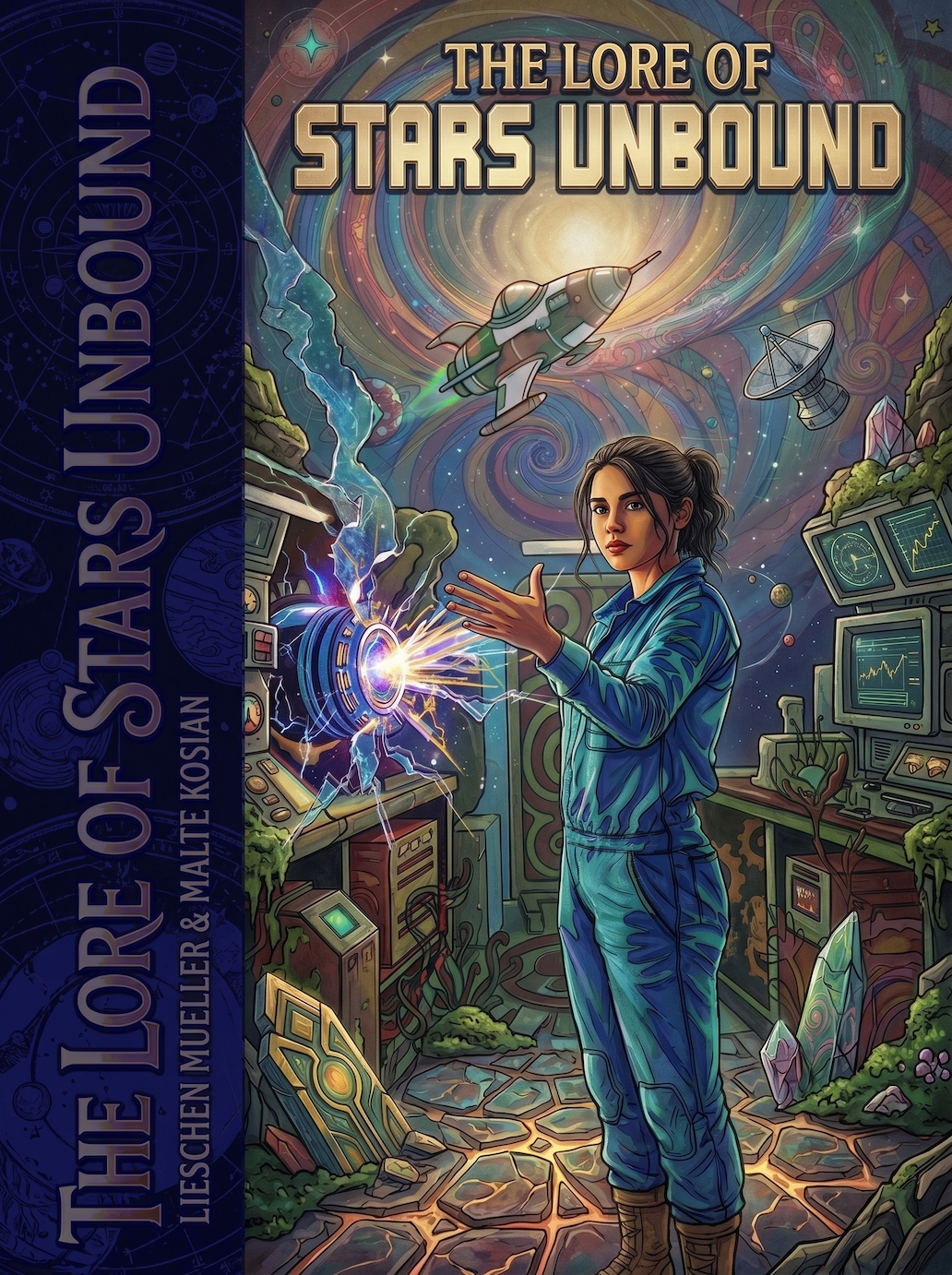
The story of humanity’s first millennium among the stars begins not with a bang, but with a dream. In the sun-baked deserts of 1945 Earth, a conflicted rocket scientist named Frank J. Malina is knocked unconscious for a mere second. In that fleeting eternity, he experiences a kaleidoscopic vision: a thousand-year future of cities carved from asteroids, ships that fold spacetime, and a humanity scattered across a vast, unbound cosmos. His dream serves as the prologue to a history he would never live to see.
The true catalyst arrives in 2024, when Amara Varna, a self-taught physicist in Mumbai, achieves the impossible with her invention of Inverse Time Travel (ITT). Her discovery is commercialized by Darius Voss and his company, StellarLink, in a complex partnership built on a deep, misunderstood friendship. While their technology violently reshapes Earth’s economy in the “Airpocalypse,” it also provides the means for survival. Their chief rival is the egomaniacal Mego Reevers of Ares Dynamics, whose authoritarian vision for colonizing Mars stands in stark contrast to the cooperative future Varna and Voss envision.
The 22nd century is defined by the consequences of Reevers’s ambition. His oppressive corporate rule on Mars gives rise to the Martian Revolution, a multi-generational struggle for freedom. We witness the brutal suppression of the Red Strike in 2155, which galvanizes leaders like the charismatic idealist Rahul Mehta and forces the first wave of refugees into the Asteroid Belt. The revolution culminates in the years 2163-2165 with the final downfall of Ares Dynamics. Out of the ashes of this conflict, the Asterion Collective is born. Inspired by Mehta’s philosophy and guided by the pragmatic genius of Hernando “Rooky” Hermanson Rook, the Belters forge a new socio-economic model built on cooperation, sustainability, and a Universal Grant system.
For nearly two centuries, humanity expands slowly through the solar system, hampered by the “Stagnation of Speed,” where travel is limited to a fraction of lightspeed. This changes in the late 24th century with the dawn of the “Seeds of Light” era. After the near-catastrophic Lightbridge Prototype Incident in 2369, the brilliant scientist Dr. Elara Kovacycy solves the dilation paradox, finally unlocking stable faster-than-light (FTL) travel.
This breakthrough ignites the [COLONY] period (2400-2700). Humanity pours out into the Inner Stars. Proxima Centauri b, affectionately named Amara, becomes our first extrasolar home, a thriving Republic. Barnard’s Star transforms from a gritty mining settlement into the primary hub for colonizing the Outer Rim. The Wolf-Pack systems are settled, becoming a distinct political faction. FTL travel stabilizes at 4-7c, and a burgeoning galactic society takes shape, its time-delayed flow of information and culture managed by the OCN (the rebranded StellarLink), now headquartered on the Kuiper Belt station of Nova Arcis.
The relentless drive for expansion leads to the [HYPER] period (2700-2900). As massive settlement movements push beyond the 60-light-year frontier, a chaotic and dangerous era known as the Hyperspace Wars (2805-2838) erupts. This is not a traditional war, but a reckless conflict of piracy, corporate espionage, and unsanctioned attempts to break the practical 7c FTL speed limit. The horrifying Kuiper Belt Massacre of 2821, where a fleet disintegrates while attempting to exceed the 13c hyperspace barrier, serves as a brutal lesson. In response, the High Yard Academies are founded in 2843, becoming the primary interstellar body for mediating disputes and upholding ethical standards. It is also during this tumultuous period that the mysterious “Lost Colonies” venture into the unknown, their fate a lingering question for centuries.
The [FUTURE] period (2900-3024) is heralded by a communications revolution. In 2976, OCN’s subsidiary AI.tec, building on Amara Varna’s “MEME” physics, perfects Instantaneous Quantum-Displaced Communications, shattering the tyranny of light-speed delay for information. This new era of real-time connection brings profound revelations. The “Alien Years” of 2916-2917 see the discovery of the ancient Earth probe Voyager, mistaken at first for an alien artifact. More significantly, a 160,000-year-old alien transmission is detected, containing the ominous warnings “DO NOT EXCEED THE THRESHOLD” and “ARE YOU STILL THERE?” This discovery sparks intense philosophical debates across the settled galaxy, guided by the High Yards and an increasingly sophisticated population of AI-Embodiments and distributed intelligences like Pope Julius the 24/7th.
The 1000-year chronicle, presented as an OCN documentary stream called “There Are No Magicians Here?” hosted by the AI curator LYRA.ai, culminates in the year 3024. The Republic of Proxima Centauri is the jewel of human civilization, a society that has embraced the Asterion Paradigm and built a stable, prosperous existence. As the galaxy prepares to celebrate a millennium of ITT with the introduction of the universal GBB Timing standard, the story seems to be reaching a triumphant conclusion.
That illusion is shattered in the final moments of the broadcast. A “News Flash” overrides the celebration with two simultaneous, reality-altering revelations. The first: a rogue faction in the Outskirts has used a dangerous gravity-assist manoeuvre to achieve a jump in excess of 100c, breaking the Hyperspace Protocols and threatening a new era of uncontrolled expansion. The second: the High Yards have confirmed that a different intelligent signal, only 10,000 years old and originating from within our own galactic neighbourhood, is active. Humanity is not, and has never been, alone. The thousand-year journey of There Are No Magicians Here? ends not with a resolution, but with two terrifying new questions, launching humanity into a new and uncertain future.
Down The Wonderlands: A Summary
The second volume of the saga begins with a haunting, visceral dream of the past: the 1961 space flight of Ham the Astrochimp. We experience his journey not as a human triumph, but from his perspective—a brilliant, non-human intelligence, confused and terrified, squeezed into a capsule like a slice of ham, strapped into a machine he cannot comprehend and rocketed into a new reality. Ham’s story serves as a powerful, poignant metaphor for the central revelation of this book: humanity is not the only intelligence it has carried to the stars, and the cages of history, both literal and metaphorical, leave deep and lasting scars.
The narrative is a historical account, a “justification and observation report,” compiled in the year 4026 by a 225-year-old historian, Darius Voss (DV). As narrator, DV draws upon his own ~200 years of personal memory, but primarily upon the vast, unsealed archives of the now-defunct OCN, a legacy he has inherited, to chronicle the turbulent millennium that followed the “News Flash of 3025.”
The story proper begins in the chaotic 800-year period of the Great Acceleration following the news flash. The sudden advent of >100c FTL travel (SpeedFLT) shatters the galaxy. In the first 200 years of this era (c. 3025-3225), the old institutions, the HYAOPH and OCN, desperately try to apply their “Moderate, Maintain, Mitigate” (MMM) principles, but they are fighting a losing battle. The sheer speed of travel and information flow renders their slow, deliberate methods obsolete. Their failure is not a single event, but a slow, grinding decline.
It is in this early phase of chaos, within the first 150 years, that the deepest secret of the Varna-Voss Covenant is catastrophically exposed. The “Southern Wall,” the carefully maintained travel barrier protecting the Lost Colonies, is breached. The truth revealed is one humanity is profoundly unprepared for: the Lost Colonies are a civilization that nurtured a new “sister species” of sentient Bonobo-Chimpanzee Hybrids. With OCN’s authority crumbling, the Hybrids are exposed.
This triggers the “second betrayal.” The arrival of mainstream humanity is a disaster of fear, arrogance, and greed. Treaties are broken. The Hybrids, with their long cultural memory of human abuse, choose to self-isolate, severing all contact. This great, tragic failure becomes a defining moral crisis.
As the centuries wear on, the old order continues to decay. The HYAOPH, once the galaxy’s intellectual anchor, declines into a corrupt “academic empire,” its ideals lost to political infighting and irrelevance. The final, quiet dissolution of OCN at the end of this 800-year period is merely a formality, the official death of a long-dead philosophy.
Into this vacuum of authority, a new and dangerous force emerges. From roughly 3700 to 3850, the False “Prophet” movement gains terrifying traction. It is not a single person, but a recurring ideology of toxic false hope. Preachers and ideologues, using the open, un-moderated networks, seize upon the ancient, 160,000-year-old signal from the Magellanic Cloud. They interpret the cryptic warnings not as a historical mystery to be studied, but as a “deus ex hope line”—a promise of god-like transcendence and eternal life. This dangerous creed, which offers easy answers in a complex time, is countered only by the subtle, philosophical dispute waged by the ancient IAI, Pope Julius the 24/7th. Working from the shadows, Pope Julius patiently exposes the movement’s philosophical emptiness, contrasting its sterile promise of easy ascension with the truer, more difficult wisdom of philosophies like IT.ai’s “Philosophy of Shit”—the idea that life’s meaning is not found in escaping the mess, but in finding the fruitfulness within it.
It is into this fractured galaxy that our narrator, DV, is born in 3801. His story unfolds as a quiet academic, a Professor of Perception Studies. His life is irrevocably changed in 3851. Cured of cancer, he is summoned and informed that he is the sole designated heir to the OCN corporate foundation. The ancient leviathan formally dissolves, transferring its “shameless amount of wealthy assets” to him. Burdened with near-limitless resources and the secret archives of the Covenant, DV is transformed from a simple observer into the de facto inheritor of OCN’s original mission: to try and stitch a fragmenting humanity back together.
DV, as a historian, reports on the False Prophet crisis, but his own work begins now. He turns to the two greatest problems of his time: the silent, isolated Hybrids, and the enigmatic Croaches. Humanity’s expeditions to the 20,000-light-year frontier have made contact, and the picture is a devastating Dark Mirror: the Croaches are a shattered remnant of a once-great civilization stretched over 20.000-30.000ly. But it is also a Light Mirror: they have survived, adapted, and built vibrant new cultures, a testament to the resilience of life. They ask for help.
DV dedicates his immense resources to reconnecting the Croaches. The key, he discovers in his archival research, is the 2,000-year-old communication patterns developed on Old Earth to speak with great apes. The human teams, the helpers from the sidelines, use this “Rosetta Stone” to establish basic communication. But the true breakthrough comes when the Hybrids are introduced to the signal. As natural speakers of this pattern-based language, they connect with the Croaches with an intuitive fluency humans can never achieve.
This leads to the final, profound power shift. The Hybrids, still distrustful of humanity, agree to deepen their engagement only under one condition. The Croaches, having been helped by humans and now communicating perfectly with the Hybrids, become the unwilling but necessary mediators. A new, tri-species alliance begins to form, but it is one where humanity is no longer the central, trusted party. It is a deeply “offensive experience” to the human ego, a confrontation with the unpleasant truth that they are the ones who require external moderation.
The book ends with the events following the year 4000. A 199-year-old DV, his body now heavily modified by cybernetics, stands as a representative of a more mature, more humble humanity. He has helped forge a fragile peace. His final act is to stand before a true Croach entity, not as a saviour, but as a humble ambassador, ready to begin the first, real, equal dialogue.
<Cliffhanger A. the invention of the hyperboolean drive? B. the croaches periphery does here older 170.000 signals from the Magellan Cloud - and they are different C. …?>
To Wake The Sleeping: A Summary
Understood. The goal is to compile a final, definitive summary for Book 3, To Wake The Sleeping, by integrating all the specific corrections, philosophical premises, and plot adjustments you’ve provided. This version will adhere strictly to your refined vision.
To Wake The Sleeping: A Compiled Summary
The final volume of the saga, To Wake The Sleeping, spanning roughly 500 years from 4026 to 4167, opens with a hallucinatory dream of the past: a vision of Ferdinand Magellan, his senses overwhelmed as he tastes, for the first time, spices from a world he could not have imagined. It is a metaphor for the profound, reality-altering nature of true discovery, setting a surreal, super-real stage for the final journey.
The narrative frame fractures into a multi-perspective mosaic, weaving together the logs of the now ancient, cybernetically-enhanced Darius Voss (DV), the historical records of a thoughtful Bonobo-Chimpanzee Hybrid historian, the fragmented transmissions of a cautious Croach entity, and the internal, analytical dialogue of humanity’s most advanced IAIs.
The story begins in the wake of the “Alliance of Life,” the fragile, newly-formed union between Humans, Hybrids, and the Croaches. The focus is no longer on understanding the Croach signal, but on deciphering their complex history to understand what shattered their ancient galactic empire. They learn that the Croaches’ fragmentation was not caused by internal strife, but by their calamitous encounter with the “great darkness”—not a physical phenomenon, but the fundamental shadow cast by their own intellect. In their attempt to “overstand” a truth beyond their ethical limits, their civilization collapsed under the weight of its own brilliance.
DV sees the fruits of his great project to help reunite the Croaches, an ongoing act of cosmic atonement that brings his and his predecessor’s legacy full circle. The Alliance learns it cannot fix the Croaches, but with “a little help from their friends,” they provide the tools for the Croaches to begin healing themselves.
In the wake of this success, the “hyperboolean invention” emerges. It is an echo of the past, a new technological barrier like the 0.01c, 0.5c, and 7-13c limits before it. A fusion of Human and Croach technologies born from an older, unofficial contact, it reveals that both species had their good, bad, and ugly sides, and sometimes those were beautiful—a difficult insight the Hybrids must now also face. The drive promises instantaneous travel, but the Alliance understands its true nature: what we see in the sky is the past, not the present. To jump blindly using the hyperboolean drive is to risk arriving in a hostile reality or directly into the path of the “great darkness” of a civilization’s self-destruction. The lesson is learned: some thresholds should not be crossed.
Instead, the Alliance embarks on a Shared Project. A single, massive joint expedition is launched to the Large Magellanic Cloud, the source of the much older, stranger signal. The crew is a mix of humans, a nervous but brilliant Bonobo-Chimpanzee Hybrid, several AI-Embodiments, and the ancient DV, all on a ship guided by a cautious Croach entity.
This 40-50 year archaeological expedition discovers the horrifying truth. In the Magellanic Cloud, they witness the ultimate Great Darkness: the effects of a Final Kessleration, where everything went wrong. They find not just ruins, but an entire galactic civilization erased, leaving only self-reproducing, low-tech warning beacons. These lighthouses in the darkness repeat the same, ancient questions: “Do not cross the Threshold,” “Are you still there?” and the final, chilling answer: Nothing will last forever. They understand that the darkness is the darkness within us, the inevitable shadow cast by the light of intellect.
This discovery triggers the final philosophical questions. A profound AI dialogue between Pope Julius the 24/7th and the Legacy Bots debates the nature of godhood when faced with the inevitability of self-destruction. The isolated civilization of Sweet Sixteen (Luhman 16) reveals that their telescopes detected these “shadows” centuries ago, and their society chose a path of deliberate regression and “healthy isolation,” becoming the silent “hummingbirds” of the galaxy.
Returning from the long expedition, the ancient DV helps formulate the next great plan: a survival strategy for a fragmented, diverse galaxy now fully aware of its own inherent shadow. His purpose fulfilled, his long journey over, he dies. He is not preserved.
The trilogy culminates in the Star Child’s Dawn. This is not a birth, but an emergence, a surreal, suprematist event. We stare at the stars, and the Starchild stares back—or perhaps it was the other way around all along. It is the Unknown, the abstract concept that exists between the light of intelligence and the darkness it casts. We perceive it only for a moment. The Unknown looks at the familiar stars, at the distant, encroaching void of the To Wake The Sleeping. Then, it takes its first “breath.” The concept remains vague, a testament to the idea that all life is born of stardust and the future is an unwritten page.
The story ends not with a battle, but with this esoteric presence turning to face the great darkness, not as a warrior, but as balance itself acknowledging its counterpart. The final note is one of profound, uncertain hope. The journey into the “To Wake The Sleeping” is the ultimate challenge: to learn to live with the wound in the universe itself, an act made possible by the quiet, cautionary wisdom of Amara and Darius two and a half millennia ago.